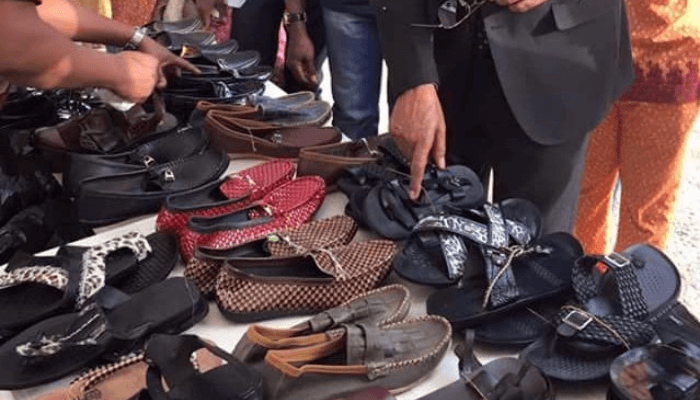

Nigeria’s bespoke shoemaking industry is seeing stronger demand for locally made footwear, but rising production costs are making it harder for shoemakers to turn that demand into sustainable profits.
The industry is caught between two opposing trends. On one hand, imported shoes have become more expensive as the naira loses value, pushing some consumers towards locally made alternatives. On the other, the same currency pressures are increasing the cost of materials, equipment and other inputs used by local producers. For small and medium sized shoemakers, the result is a difficult business environment where more customers do not necessarily mean higher profits.
The price of leather has increased alongside the cost of soles, gum, threads, buckles and packaging. Machinery and spare parts are also expensive because many are imported. Even locally sourced materials can become more costly when suppliers depend on imported inputs. Okiki, a bespoke shoemaker, said the increase in input costs has directly affected his earnings.
“The increase has affected my business seriously,” he said, adding that higher production expenses have reduced his profit on each pair.
Electricity has added another burden. Unreliable power supply means shoemakers often have to spend more on fuel to keep production going. Labour costs have also risen as workers demand better pay to cope with higher living expenses. These pressures are particularly significant for businesses that operate on a small scale. Unlike large manufacturers that can spread their costs across thousands of units, bespoke shoemakers often produce in smaller quantities. This leaves them with a higher cost per pair and less room to absorb sudden increases in expenses.
Despite these challenges, demand for locally made shoes is growing. The weaker naira has made imported footwear more expensive, giving Nigerian producers an opportunity to compete on price. At the same time, more consumers are showing interest in locally made products, particularly when they can get quality footwear designed to their preferred size, colour and style.
“There is more awareness about Nigerian made products,” Okiki said.
The growth in demand presents an opportunity for Nigeria’s footwear industry, particularly in major production clusters such as Aba. The city has a large network of leather workers and footwear manufacturers and remains an important part of Nigeria’s local manufacturing base. Government agencies have also identified Aba’s footwear industry as a potential source of import substitution. An Aba based shoe and garment factory was reported to have a production capacity of 1,500 shoes a day in 2025, while a tannery project in Kano was expected to strengthen domestic leather supply.
These developments could help reduce Nigeria’s reliance on imported footwear and create more opportunities for local producers. But the ability of small shoemakers to benefit from the market will depend on how well they can manage their production costs. For Okiki, controlling spending has become central to keeping the business afloat. He compares prices from suppliers, buys materials in larger quantities when possible and tries to minimise waste. He also relies on made to order production and customer deposits to improve cash flow. This approach reduces the risk of spending heavily on stock that may remain unsold.
“I take orders and sometimes require deposits before production,” he said.
Quality is another part of the strategy. Rather than competing solely on price, Okiki focuses on producing footwear that encourages repeat purchases and customer referrals. For bespoke producers, this can provide an advantage over mass produced alternatives. However, competing with imported footwear remains difficult.
Foreign manufacturers often benefit from large scale production, cheaper equipment and established supply chains. Nigerian shoemakers, many of whom operate as small businesses, face higher production costs while having limited access to modern machinery and affordable financing. Okiki said better access to equipment, finance and reliable electricity would help local producers compete more effectively.
The government, he added, could support the industry through affordable loans, improved power supply, access to modern machinery and practical training in shoemaking, business management and marketing.
Nigeria’s footwear market therefore presents both an opportunity and a warning. Rising demand shows that consumers are increasingly willing to consider locally made shoes, but demand alone cannot solve the structural problems facing producers. If electricity remains unreliable, machinery remains expensive and financing remains difficult to access, higher sales may not translate into stronger businesses.
For Nigeria’s bespoke shoemakers, the market is opening. Their challenge now is to turn growing consumer interest into lasting growth by lowering production costs, improving efficiency and competing on quality.