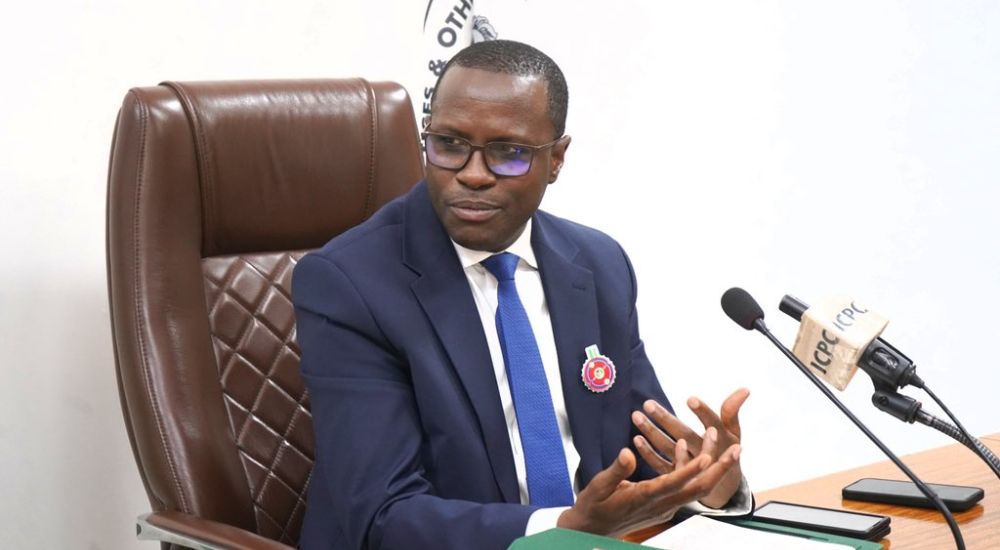

Nigeria’s anti-corruption drive must be treated as an economic policy priority rather than solely a law-enforcement exercise, the chairman of the Independent Corrupt Practices and Other Related Offences Commission (ICPC), Musa Adamu Aliyu, has said.
Aliyu said stronger controls over public spending, procurement and government payrolls were essential to improving Nigeria’s investment climate, protecting scarce public resources and strengthening confidence in state institutions.
He spoke in Abuja at the 4th Economic Confidential Lecture and 6th National Spokespersons Awards, organised by Image Merchants Promotions Limited, where he addressed the link between anti-corruption reforms, economic stability and effective government communication.
According to the ICPC chairman, corruption raises the cost of governance, diverts resources from productive investment and undermines the impact of economic reforms.
Aliyu said the commission tracked 4,582 public projects with a combined value of more than ₦22.53 trillion between 2023 and June 2026 under its Constituency and Executive Projects Tracking Initiative.
He said the intervention helped return projects worth ₦507.04 billion to construction sites and generated estimated savings of ₦385.62 billion for the Federal Government.
The figures highlight the economic value of monitoring public expenditure, particularly in an environment where fiscal constraints have increased pressure on government to achieve better value from every naira spent.
Aliyu also disclosed that the commission secured a Federal High Court order for the forfeiture of properties worth more than ₦5 billion in a case involving the Federal Mortgage Bank of Nigeria. The court, he said, directed that 962 housing units be completed.
The ICPC chairman also disclosed cases of alleged payroll manipulation involving government employees and their relatives.
He said investigators found an official who allegedly placed 14 family members on the government payroll, while another individual allegedly enrolled his wife, children and other relatives and received 13 salaries.
Aliyu said the commission had identified about 900 suspected ghost workers, people listed on government payrolls who investigators believe may not be genuine employees, and published their names for verification.
He said the commission recovered more than ₦24 billion linked to ghost-worker pensions in 2024, warning that fraudulent personnel records can create further leakages through pensions, housing funds, mortgages and health insurance.
Aliyu said the ICPC was increasingly focused on preventing losses before they occur rather than relying exclusively on prosecutions after public funds have been misappropriated.
He called for greater use of data analytics, fraud detection, procurement monitoring and anomaly detection to identify suspicious transactions and payroll patterns early.
Information Minister Mohammed Idris similarly argued that Nigeria’s anti-corruption campaign should move beyond arrests and prosecutions towards stronger institutions and systems capable of preventing abuse.
For Nigeria, the challenge is increasingly one of fiscal efficiency as much as enforcement: plugging leakages can increase the resources available for infrastructure and public services without requiring additional borrowing or taxation.