
Nigeria’s labour market is not a single national challenge but six different regional crises requiring separate solutions, according to a new report by SBM Intelligence, which warns that a uniform employment policy will fail to address the country’s growing jobs crisis.
The report, titled Six Zones, One Crisis: What Nigerians Say About Jobs, Skills and the Risk of Leaving, surveyed 1,180 people across 21 cities in all six geopolitical zones between July 7 and 18, 2026. It found that 45.3 percent of households experienced a job loss, business closure or inability to find work within the past year, while 79.1 percent of respondents said they would consider relocating to another part of the country for better employment opportunities.
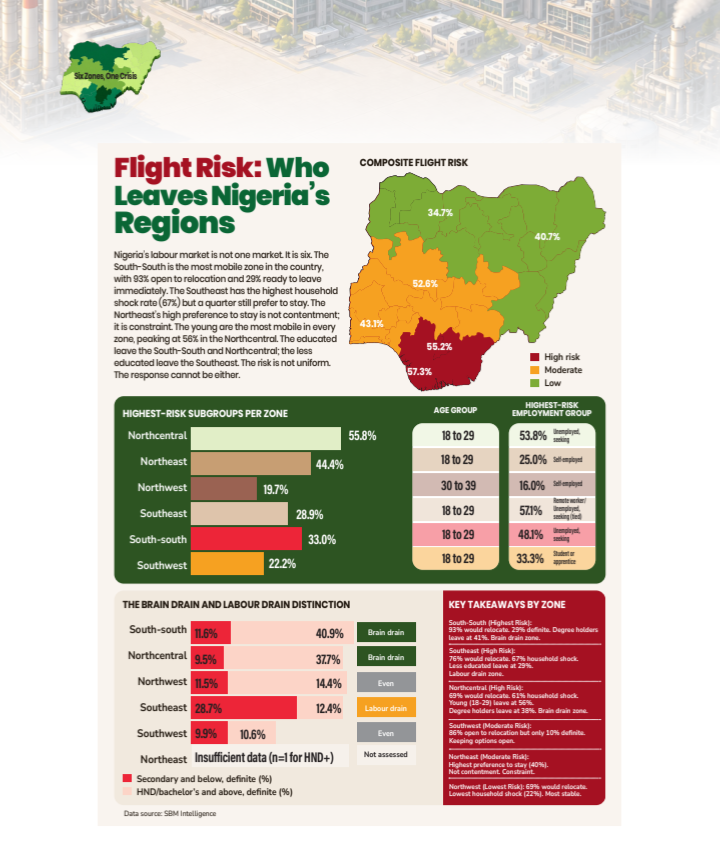
According to the report, the country’s employment challenge differs significantly across regions, with each zone facing unique economic realities. While the South South struggles with industrial decline and talent migration, the Southeast is battling the highest level of household economic shock. The Northwest and Northeast face severe skills shortages, while the Southwest is held back mainly by low wages and inadequate infrastructure. The South South recorded the highest willingness to relocate, with 92.6 percent of respondents saying they would move elsewhere for a better job. Nearly three in every 10 respondents from the region said they would leave immediately if the opportunity arose. Researchers described this as the country’s highest talent flight risk, warning that the region continues to lose skilled workers despite its strategic importance to Nigeria’s oil industry.
The Southeast recorded the highest household economic shock, with 66.5 percent of respondents reporting job losses, business closures or inability to secure employment within the last 12 months. However, unlike the South South, many residents expressed a stronger desire to remain if economic conditions improve, suggesting that better infrastructure and business opportunities could slow migration from the region.
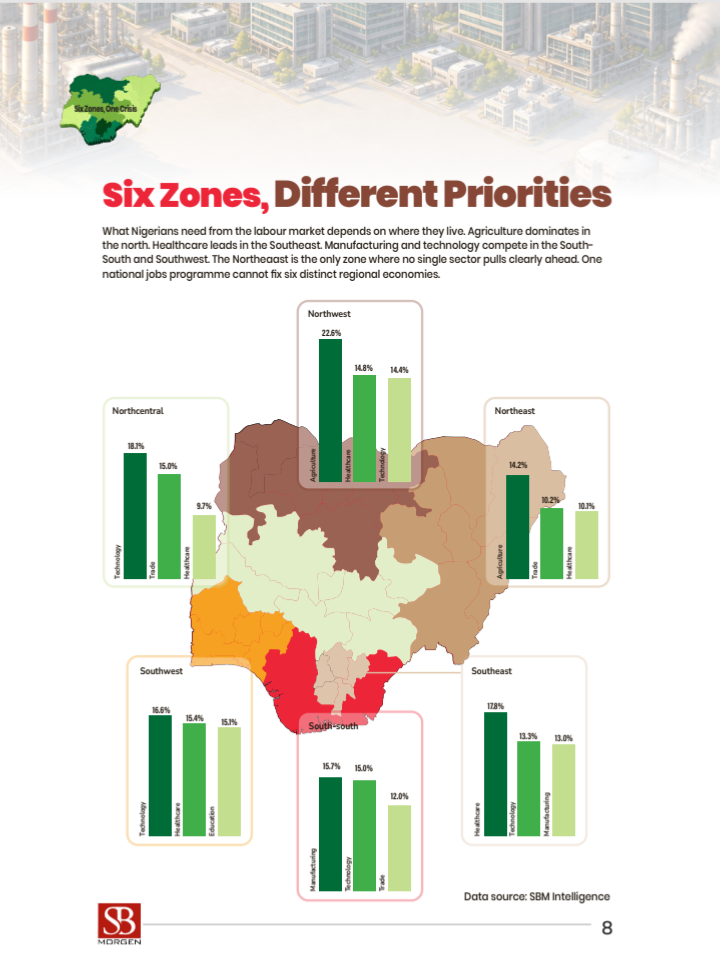
Nationally, respondents identified technology, agriculture and healthcare as the sectors requiring the most urgent investment to create jobs. However, regional priorities varied considerably. Agriculture emerged as the leading priority in both the Northwest and Northeast, healthcare ranked highest in the Southeast, manufacturing topped the list in the South South, while technology was identified as the biggest opportunity in the Southwest and Northcentral.
The report also found that digital skills have become the most sought after training area across Nigeria. More than half of respondents chose digital skills as their preferred form of training, making it the leading skills demand in five of the six geopolitical zones. The Northeast was the only exception, where construction related skills ranked ahead of digital training because of local economic realities.Young Nigerians were identified as the most likely to relocate. Respondents aged between 18 and 29 recorded the highest willingness to leave in five of the six geopolitical zones. Degree holders in the South South and unemployed people in the Southeast and Northcentral also showed particularly strong intentions to relocate, raising concerns over an increasing loss of skilled workers.
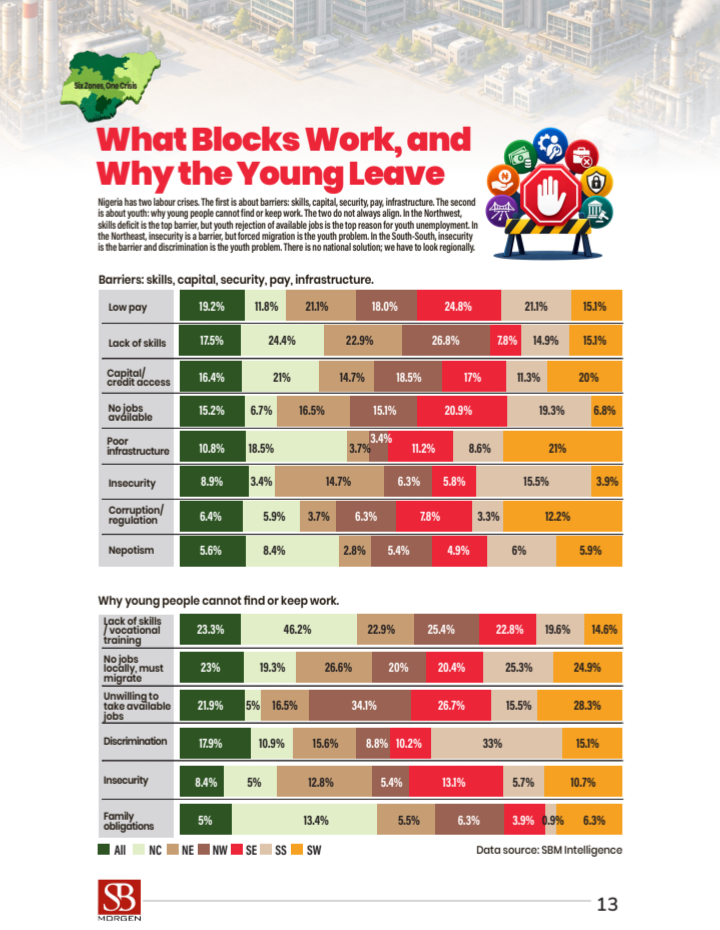
The survey further revealed that many Nigerians believe employment opportunities are increasingly influenced by connections rather than merit. Nepotism, poor access to finance, low wages and limited infrastructure were repeatedly identified as barriers preventing people from securing decent jobs or expanding businesses.
To address the crisis, SBM Intelligence urged governments at both the federal and state levels to adopt region specific employment strategies rather than implementing uniform national programmes. Among its recommendations are investment in inter regional economic corridors, expansion of digital skills training through vocational institutions, easier access to credit for small businesses, improved labour market data, stronger support for manufacturing and agriculture, and reforms to promote merit based recruitment in public institutions.
The report also called on the federal government to strengthen rail, power and transport links connecting key economic corridors such as Port Harcourt to Aba, Kano to Kaduna to Abuja, and Lagos to Ibadan. It argued that these investments would stimulate regional economic growth while reducing pressure on already congested urban centres.
SBM Intelligence concluded that Nigeria’s labour market has become deeply fragmented by geography, infrastructure, security and economic structure. It warned that unless governments recognise these regional differences and design targeted interventions, the country will continue to lose productive workers to internal migration, worsening unemployment and slowing economic development.