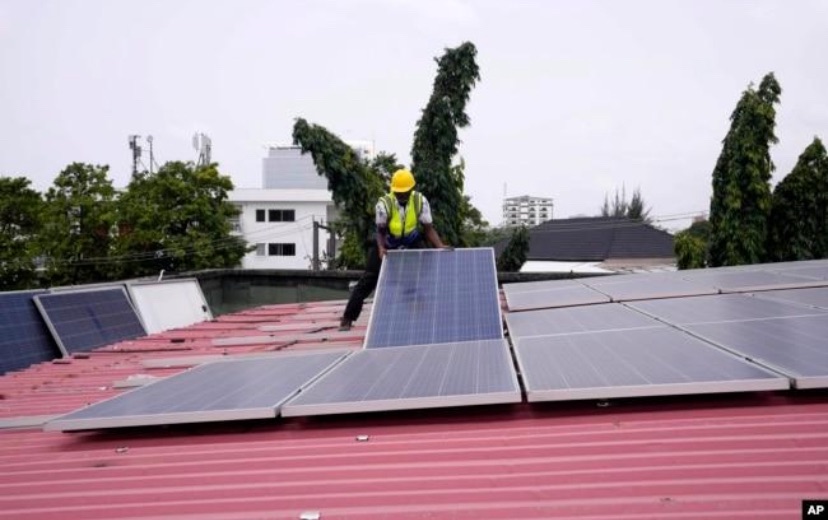

The Federal Government has urged Nigerian businesses and investors to increase the local production of solar panels, batteries, inverters and other renewable energy equipment as the country seeks to reduce its dependence on imports.
The government said Nigeria has the resources, workforce and market potential to become a major producer and exporter of renewable energy technologies rather than remaining largely dependent on foreign products.
The Senior Special Assistant to the President on Climate Technology and Operations, Prof. Olamide Fagbuji, made the call at the Lagos Solar Forum, where stakeholders discussed ways to improve electricity access through renewable energy.
Fagbuji said Nigeria needed a deliberate industrial strategy that would encourage the country to manufacture, assemble and eventually export clean-energy technologies.
He explained that increasing local production could create jobs, strengthen technical skills, reduce pressure on foreign exchange and support the government’s broader industrialisation agenda.
According to him, Nigeria’s large and youthful population provides an opportunity to develop a skilled workforce for the growing global green economy. He called for more investment in technical education, apprenticeships, research and professional training.
The government official also pointed to the huge amount of money flowing into the global clean-energy industry. Global investment in clean energy has already exceeded $2tn annually, while the International Energy Agency estimates that investment could need to rise to about $4.5tn every year by 2030 to achieve global net-zero targets.
Despite Africa’s enormous renewable energy potential, the continent currently receives only a small share of global clean-energy investment.
Nigeria, however, has strong solar resources, with solar radiation averaging between five and seven kilowatt-hours per square metre per day across much of the country. Fagbuji said the major challenge was now turning this natural advantage into affordable and reliable electricity for Nigerians.
Stakeholders at the forum, however, warned against rushing into a complete ban on imported solar equipment.
Dr Michael David, Executive Director of the Global Initiative for Food Security and Environmental Protection, said Nigeria should first strengthen its local manufacturing capacity before restricting imports.
He argued that millions of Nigerians still lack dependable electricity and have increasingly turned to solar power as an alternative to the national grid.
According to David, immediately banning imported solar products could make panels, batteries and inverters more expensive and slow down the expansion of renewable energy.
Instead, he recommended government incentives for local manufacturers, support for assembly plants and easier financing for households and businesses buying clean-energy systems.
Daniel Awolaja, who presented an overview of Nigeria’s energy investment landscape, said the country still faces a major electricity supply problem despite having about 14 gigawatts of installed generation capacity.
He noted that only about 5GW is consistently delivered through the national grid, leaving many consumers with unreliable power.
Awolaja said Nigeria had attracted about $100bn in disclosed energy investments over the past decade, but roughly 92 per cent went into oil and gas. He called for more investment in renewable energy, transmission, distribution and energy storage.
He added that Nigeria recorded significant growth in solar adoption, with more than 800MW of solar capacity added in 2025.
Stakeholders agreed that Nigeria’s renewable energy future will depend not only on generating more power but also on building local industries, improving financing and strengthening cooperation among government agencies, private companies and development organisations.
The emerging consensus is that Nigeria should gradually build its domestic clean-energy manufacturing industry while keeping access to affordable imported equipment until local production becomes strong enough to meet demand.