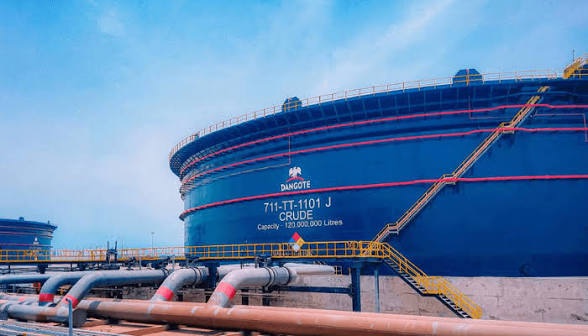

The Dangote Group has unveiled plans to build a petroleum products storage terminal in Cameroon as part of its strategy to expand the reach of the Dangote Refinery across Central Africa.
The proposal was presented to Cameroon’s Prime Minister, Joseph Dion Ngute, by the company’s Vice President for Oil, Gas and Fertiliser, Devakumar Edwin. While discussions have started, both parties are yet to announce a final agreement, meaning the project is still in its early planning stage.
If approved, the storage terminal would serve as a major distribution hub for refined petroleum products produced at the 650,000-barrel-per-day Dangote Refinery in Lekki, Lagos. The facility is expected to strengthen fuel supply across Cameroon while creating a faster and more efficient route for exporting refined products to neighbouring countries.
According to details of the proposal, the terminal could also include a pipeline network that would transport fuel directly from storage facilities to different locations. This would reduce the heavy dependence on fuel transportation by trucks, helping to lower logistics costs, reduce traffic congestion and cut carbon emissions.
The project could also help Cameroon build stronger strategic petroleum reserves, making the country’s fuel supply more stable during periods of market disruption or global supply shortages.
Although the Dangote Group has confirmed its interest, important details remain undisclosed. The company has not revealed where the terminal would be located, how much fuel it would store, the estimated cost of construction or the timeline for completion. It is also unclear whether the project would be fully financed by Dangote, developed jointly with the Cameroonian government or executed through a public-private partnership.
Beyond serving Cameroon, the proposed terminal could become a major supply centre for landlocked Central African nations such as Chad and the Central African Republic. These countries rely heavily on Cameroon’s ports to import petroleum products, making the location strategically important for regional fuel distribution.
By placing fuel inventories closer to consumers, the project is expected to reduce delivery times, improve supply reliability and lower transportation expenses across the region.
The proposal comes at a time when Cameroon is already investing heavily in expanding its petroleum storage infrastructure. The country’s National Petroleum Storage Company is constructing a new terminal in Kribi with a storage capacity of about 230,000 cubic metres for petrol, diesel and kerosene, alongside facilities for liquefied petroleum gas.
In addition, the CSTAR Tank Farm Project, backed by Ariana Energy, Tradex and Cameroon’s National Hydrocarbons Corporation, is developing another large storage facility expected to hold between 250,000 and 300,000 cubic metres of petroleum products. Together, both projects are expected to add nearly half a million cubic metres of new fuel storage capacity to the country’s downstream oil sector.
Industry observers believe Dangote’s proposed terminal could either complement these existing investments by increasing available fuel supplies or compete with them for access to port facilities, pipelines, financing and petroleum product volumes.
If the project eventually receives approval, it would mark Dangote Group’s entry into Cameroon’s downstream petroleum industry, adding to its existing cement business in the country.
The proposal also reflects the company’s broader ambition to build a regional fuel distribution network powered by the Lekki refinery. Since beginning operations, the refinery has steadily increased exports to African countries and international markets, positioning itself as one of the continent’s most important suppliers of refined petroleum products.