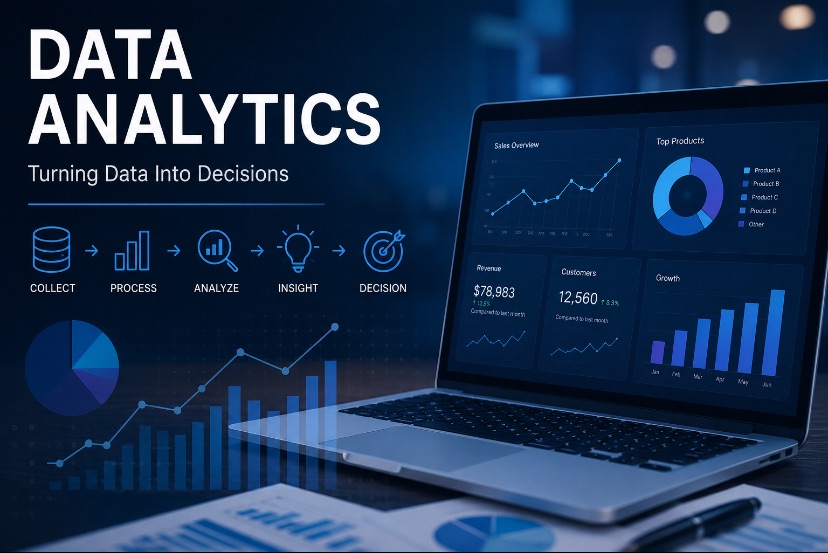

Businesses around the world are paying more attention to data analytics than ever before. From small startups to large international companies, organizations are using data to understand customers, improve services, and make smarter business decisions. As technology continues to grow, data analytics is becoming one of the most valuable tools for success.
Data analytics is the process of collecting, organizing, and studying information to find useful patterns and trends. Instead of making decisions based on guesses, businesses now rely on facts and real-time data. This helps them reduce risks, improve efficiency, and increase profits.
One of the biggest reasons for the growing demand for data analytics is customer behavior. Every time people shop online, use a mobile app, or visit a website, they create valuable information. Businesses analyze this data to learn what customers like, what products are popular, and what improvements are needed. This allows companies to provide better services and personalized experiences.
Retail companies, for example, use data analytics to predict which products customers are most likely to buy. Banks use it to detect unusual transactions that may indicate fraud. Healthcare providers analyze patient information to improve treatments and reduce medical errors. Even sports teams use data to study player performance and develop winning strategies.
Artificial intelligence (AI) has also made data analytics more powerful. AI tools can process millions of pieces of information in a short time, helping businesses identify trends much faster than traditional methods. Companies can now predict future sales, manage inventory more effectively, and improve customer support using AI-powered analytics.
Small businesses are also benefiting from this technology. In the past, advanced analytics tools were expensive and available mainly to large corporations. Today, cloud-based software has made data analytics affordable for businesses of all sizes. This allows entrepreneurs to compete more effectively by making informed decisions based on accurate information.
However, the rapid growth of data analytics also brings challenges. Businesses must protect customer information from cyber threats and follow privacy laws. Consumers are becoming more aware of how their personal data is collected and used. Companies that fail to protect sensitive information risk losing customer trust and facing legal penalties.
Another challenge is the shortage of skilled data professionals. Many businesses are looking for data analysts, data scientists, and business intelligence experts who can turn complex information into meaningful insights. As a result, universities and online learning platforms are offering more courses in data analytics to meet the increasing demand.
Industry experts believe data analytics will continue to shape the future of business. Companies that invest in modern analytics tools and skilled professionals are expected to gain a competitive advantage. Better decision-making, improved customer satisfaction, and increased efficiency will remain key benefits for organizations that successfully use data.
As the digital economy continues to expand, data is becoming one of the world’s most valuable business assets. Companies that understand how to transform raw information into smart decisions will be better prepared to adapt to changing markets and customer needs. In today’s competitive business environment, data analytics is no longer just a technology trend—it has become a core part of long-term business success.