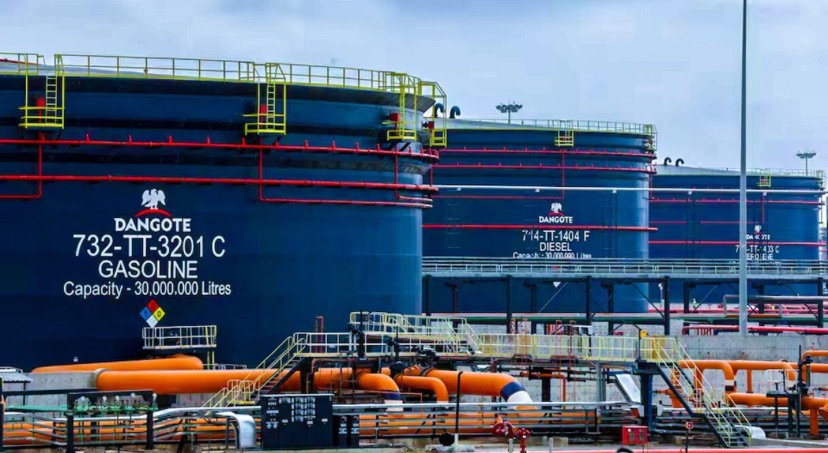

Africa’s largest refinery, the Dangote Refinery, has reduced production at its main petrol processing unit by about 34 percent since May 21 due to a technical fault, according to industry monitoring reports.
The issue affected the refinery’s Residual Fluid Catalytic Cracking Unit (RFCCU), a critical facility responsible for converting heavy oil residues into valuable products such as petrol, diesel, and liquefied petroleum gas (LPG).
Industry tracker IIR Energy revealed that the unit was operating below capacity after a flue gas slide gate valve developed a fault. The company noted that repair work is nearly completed and the unit is expected to resume full operations by the middle of June.
According to IIR Energy, the refinery initially faced challenges because it was processing lighter crude oil, which did not provide enough feedstock for the RFCCU. Later, the valve malfunction further affected operations and reduced production levels.
Efforts to obtain comments from the Dangote Group were unsuccessful. The company’s spokesman, Anthony Chiejina, reportedly promised to respond to inquiries but had not done so as of the time of reporting.
The temporary reduction in operations has already affected fuel exports. Data from commodities analytics firm Kplershowed that petrol exports from the refinery dropped significantly from approximately 81,000 barrels per day in Aprilto 17,000 barrels per day in May. Export volumes have averaged around 10,000 barrels per day so far in June.
The 700,000 barrels-per-day Dangote Refinery, regarded as the world’s largest single-train refinery, began full-scale operations earlier this year after years of development and billions of dollars in investment.
The refinery was established to help Nigeria reduce its dependence on imported petrol despite being one of Africa’s largest crude oil producers. Since commencing operations, it has increasingly supplied fuel to both Nigeria and neighboring West African countries.
Its growing role in the regional fuel market means that any disruption in production is closely monitored by fuel traders, marketers, and governments across Africa. The refinery has already begun reshaping fuel trade patterns that were previously dominated by suppliers from Europe and other regions.
The production cut also comes at a time when global oil prices are rising due to geopolitical tensions in the Middle East. Higher crude prices have increased concerns about fuel costs worldwide.
In Nigeria, where petrol prices remain highly sensitive to international oil prices and exchange-rate fluctuations, any reduction in domestic refining capacity can raise concerns about fuel availability and market stability.
Although industry experts expect the affected unit to return to full capacity within days, the incident has highlighted the strategic importance of the Dangote Refinery to Nigeria’s energy security and Africa’s refined petroleum supply chain.
The development underscores how critical the refinery has become in ensuring stable fuel supplies across the region, making even temporary operational issues significant for the broader energy market.