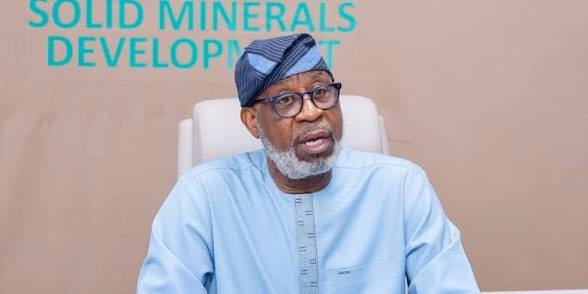

The Minister of Solid Minerals Development, Dele Alake, has stated that the removal of fuel subsidy in 2023 by President Bola Tinubu’s administration helped prevent Nigeria’s economy from falling into collapse.
He made this remark during the 2026 joint stakeholder sensitisation programme organised by the Nigeria Revenue Service and the Ministry of Solid Minerals Development in the North Central region. According to him, the decision to end fuel subsidy was a difficult but necessary step that helped stabilise the country’s financial system at a critical time.
Alake explained that before the current administration took office, Nigeria was already facing severe economic challenges. He noted that the country had been borrowing heavily not for development projects, but simply to pay workers’ salaries and manage day-to-day government expenses. He warned that such a pattern is unsustainable and often signals deep economic distress.
He further revealed that Nigeria’s credit ratings had declined significantly, making it difficult for the government to access international loans. According to him, lenders had become reluctant to support the country due to concerns about its rising debt profile and weak repayment capacity.
The minister also claimed that at a point of extreme pressure, the country resorted to printing large amounts of money locally, estimating that over ₦20 trillion was injected into circulation. He said such actions contributed to inflationary pressure and weakened the overall economy.
Alake traced part of Nigeria’s economic challenges back to earlier decades, stating that the country gradually shifted from local production to heavy dependence on imports. He explained that between the 1960s and early 1980s, Nigeria had a stronger industrial base, but over time, the economy became consumption-driven rather than production-focused.
He added that this shift encouraged excessive importation of goods that could have been produced locally, leading to the closure of factories and widespread job losses. According to him, billions of dollars were spent importing non-essential goods, including items such as wigs, instead of investing in local industries.
The minister criticised past administrations for failing to reverse the trend, saying that the absence of bold reforms allowed economic weaknesses to deepen over time. He argued that this lack of decisive action contributed to long-term structural problems in the economy.
However, Alake said the current administration is taking deliberate steps to correct these issues. He explained that ongoing reforms are aimed at blocking financial leakages, improving revenue generation, and building a more sustainable economic structure for the future.
In a related development, the Permanent Secretary of the Ministry of Solid Minerals Development, Faruk Yabo, stressed the importance of repositioning Nigeria’s mining sector as a major driver of economic diversification. He said the sector has the potential to create jobs, increase revenue, and support national development if properly managed.
Yabo also emphasised the need for transparency, compliance, and stronger collaboration between government agencies and industry operators. He noted that aligning mining operations with the 2025 Tax Reform Act is essential for eliminating revenue losses and ensuring better returns from Nigeria’s mineral resources.
The sensitisation programme, themed “From Resource to Revenue: Aligning Solid Minerals Operations with the 2025 Tax Reform Act,”is part of a nationwide effort to educate stakeholders on new royalty collection systems. Under the new arrangement, the Nigeria Revenue Service will handle mineral royalty collection, while the ministry will continue to provide regulatory and technical oversight.