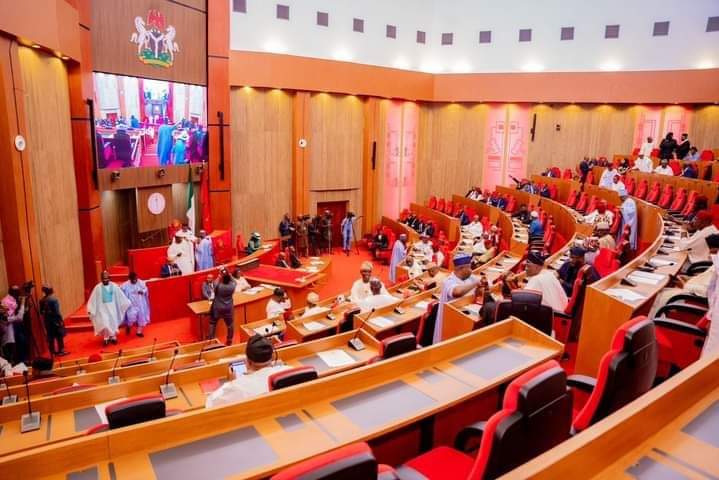

The debate over Nigeria’s ambitious Electoral Act (Amendment) Bill 2025 came to an abrupt, dramatic stop in the Senate last week, exposing fundamental flaws in the country’s legislative process. What should have been a routine second reading for the landmark reform package descended into a chaotic procedural standoff, ultimately forcing the bill to be shelved. The reason for the halt was remarkably simple, yet profoundly embarrassing: the text of the proposed law had not been circulated to the very senators expected to debate it. This embarrassing lack of preparation raised serious questions about the diligence and operational integrity of the institution responsible for drafting the nation’s laws.
The Upper Chamber, set to discuss a measure intended to revolutionise Nigeria’s elections, was temporarily presided over by the Deputy Senate President, Senator Jibrin Barau. He urged his colleagues to proceed, arguing that the legislative tradition only required them to discuss the “general principles” of the bill at that stage, not its intricate details. However, this appeal was met with palpable discomfort and rising dissent. Senators protested vociferously, murmuring objections from their seats. “How are we meant to discuss a bill that is not even before us?” one lawmaker was heard saying, questioning the rationale of debating a document that was effectively unseen. The mood in the chamber was one of disbelief, with critics privately likening the situation to attempting to host a public meeting about a proposed law that, for all intents and purposes, did not yet exist.
The controversy was quickly compounded by deeper concerns about procedural integrity. It soon became evident that the lack of the bill’s text was merely the most visible symptom of a more significant, underlying procedural blunder committed by the Senate Committee on Electoral Matters, chaired by Senator Simon Lalong. Lawmakers pointed out that the Committee had already gone ahead and conducted a public hearing on the bill. Under established parliamentary protocol, committees are only permitted to seek public input on a bill after it has successfully passed the second reading—the very stage it was currently stalled at. This act was roundly described by observers and some senators as putting “the cart before the horse,” a move that fundamentally undermined the integrity of the law-making process. The question was a rhetorical one, yet critical: how could a committee gather public opinion on an electoral reform bill that the federal lawmakers themselves had yet to formally consider or approve in principle? The episode drew sharp criticism from political commentators, who suggested the lapse indicated an alarming breakdown in legislative coordination.
Order and authority were swiftly restored when the Senate President, Senator Godswill Akpabio, returned to the chamber. Immediately assessing the volatile situation, he decisively intervened, cutting through the confusion caused by his deputy’s earlier directive. To loud applause from his colleagues, Senator Akpabio made it clear that the Senate would not proceed. “This Senate will not discuss what it has not seen,” he declared firmly. “We must be guided by procedure, not by assumption. You simply cannot debate a document that is not before you.” This strong pronouncement brought the proceedings to an immediate and conclusive halt. The Senate Leader, Senator Opeyemi Bamidele, subsequently moved a motion for the bill to be officially stepped down to allow for “further consultation and proper circulation of the text,” a motion which was unanimously supported by a voice vote. Akpabio concluded by stressing the importance of diligence and transparency, stating, “The time today is not auspicious to proceed… Nigerians expect us to conduct ourselves with transparency and diligence. Let us not debate an unseen bill.”
Despite the embarrassing setback, the content of the proposed 2025 Electoral Act Amendment Bill remains a vital, far-reaching effort aimed at salvaging public trust in the country’s democratic institutions. The reform package is described by its lead sponsor, Senator Lalong, as a “holistic reform package” specifically designed to address and close the various legal and operational loopholes exposed during the widely scrutinised 2023 general elections. Its core objectives are manifold and ambitious. Key provisions within the bill include the early and predictable release of election funding to the Independent National Electoral Commission (INEC), providing essential clarity on the often-controversial electronic transmission of results, and establishing a sophisticated digital voter register that would feature QR-coded identity cards. Furthermore, the bill seeks to mandate stronger internal democracy within political parties by imposing stricter rules for party primaries and candidate substitution processes. Critically, it also proposes significantly harsher penalties for serious electoral offences such as vote-buying, the falsification of results, and various other electoral crimes.
Senator Akpabio used the opportunity not just to enforce procedure but also to weigh in on the substance of the reform, drawing on his own contentious political history. He spoke candidly about his personal experience of being “cheated” in the 2019 elections, where a court later annulled the result and ordered the prosecution of the returning officer. He argued that any genuine reform must ensure INEC itself is more accountable for infractions directed from the top, rather than merely punishing junior field officers. “We cannot continue punishing lower officers for crimes directed from the top,” a visibly frustrated Akpabio stated, emphasising that INEC’s institutional leadership must bear responsibility. He also voiced concerns over the excessively long campaign timelines, arguing that the prolonged electioneering season disrupts effective governance by drawing ministers and public officials away from their duties for extended periods, a practice he insisted suffers when politics consumes everything.
For political observers, the entire episode was viewed as much more than a simple clerical error. It was interpreted as a clear assertion of authority by Senate President Akpabio over the chamber, and a firm reminder that the rules of legislative engagement must be respected. While the delay was frustrating for civil society groups keen to see the reforms implemented, analysts agreed that Akpabio’s decision to defer the bill was a necessary step to safeguard parliamentary due process. Ultimately, the postponement was not a rejection of the bill’s critical purpose but a tactical pause. The Senate is widely expected to revisit the bill in the coming weeks, but only after the required text has been properly circulated and members have been fully briefed, reinforcing the fundamental democratic principle that a credible law-making process is just as important as the law itself.