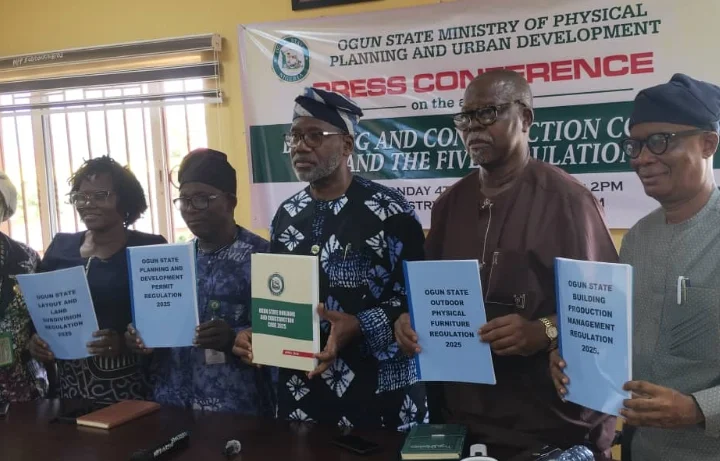

The Ogun State Government has introduced a fresh set of planning regulations alongside a comprehensive building and construction code to promote safer, more organised, and environmentally friendly urban growth across the state.
Speaking at a press briefing in Abeokuta, the Commissioner for Physical Planning and Urban Development, Olatunji Odunlami, explained that the initiative marks a major step forward in managing the state’s rapid expansion. He noted that the newly approved framework includes five updated regulations and the Ogun State Building and Construction Code 2025, all endorsed by the Ogun State House of Assembly.
The five regulations cover key areas such as development permits, slum regeneration, building production management, outdoor physical furniture, and land layout and subdivision. Together, they aim to guide physical development while addressing the challenges that come with urban growth. According to Odunlami, the building and construction code, adapted from the National Building Code, is a groundbreaking move, as it represents the first time any Nigerian state has developed such a detailed framework tailored to its needs.
“The approval of these documents represent a bold and necessary step toward ensuring that Ogun state remains orderly, safe, environmentally sustainable, and nationally recognised in physical planning and urban development,” he said.
He explained that the decision to update the regulations was driven by the state’s rapid urbanisation and economic progress, describing Ogun as one of the fastest-growing economies at the subnational level in Nigeria. He credited this growth to the leadership of Governor Dapo Abiodun, whose policies have strengthened infrastructure, improved security, and increased investor confidence.Odunlami made it clear that adherence to the new rules is compulsory. He warned that anyone who violates them risks facing penalties, demolition of illegal structures, or even prosecution. He stressed the importance of proper regulation, noting that unchecked development could lead to poor living conditions, the spread of informal settlements, building collapses, and environmental damage.
“As growth is desirable, unregulated development can result in poor urban living, informal settlements, building collapse and environmental degradation. Government has strengthened its agencies and improved planning permit processes to ensure efficient service delivery,” he said.
To improve efficiency and transparency, the government has also introduced an electronic planning system in selected pilot areas, including Isheri, Ota, Abeokuta Metro, Abeokuta Central, Sagamu, and Ijebu-Ode. This platform allows residents and developers to submit applications online. “This initiative is designed to make the planning permit process more transparent, accessible and efficient,” he said.
The commissioner also expressed concern about ongoing encroachment on road setbacks, describing it as illegal and dangerous. He identified major routes affected by such activities, including the Lagos-Ibadan Expressway, Sagamu-Benin Expressway, and Lagos-Abeokuta Highway, among others.
He directed property owners along these corridors to remove all unauthorised structures, warning that the government would no longer tolerate such violations.Finally, Odunlami called on developers, professionals, and residents to study and fully comply with the new regulations. He emphasised that building a safe, organised, and sustainable environment requires collective responsibility from all stakeholders.