
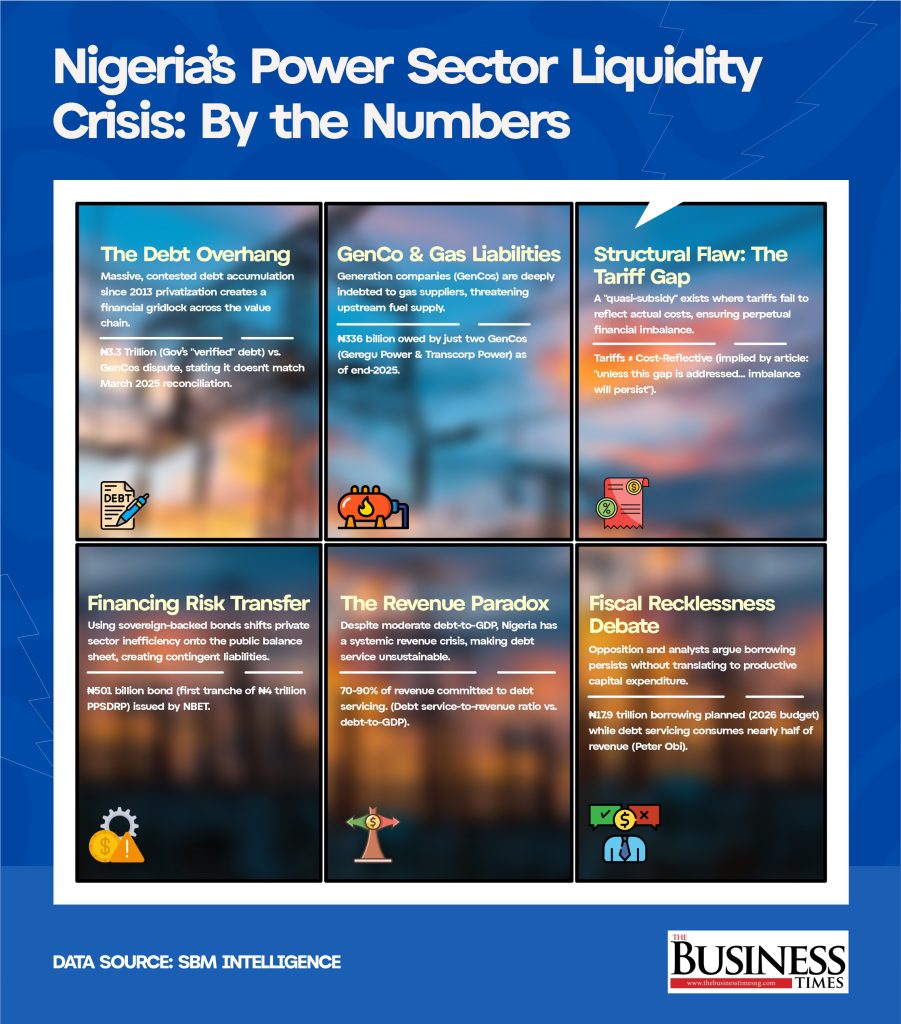
The Federal Government’s latest attempt to resolve the long-standing liquidity crisis in Nigeria’s power sector marks one of the most ambitious interventions in recent years, but it raises deeper structural questions about sustainability, transparency, and risk transfer. At the centre of the plan is the N3.3 trillion debt settlement framework under the Presidential Power Sector Debt Reduction Programme (PPSDRP), with eight generation companies covering 15 power plants signing on to the initiative. While the government frames this as a decisive step toward stabilising the electricity value chain, industry stakeholders remain sceptical about whether the plan addresses root causes or merely resets the cycle of debt accumulation.
The mechanics of the settlement reveal both progress and contention. So far, agreements worth N2.3 trillion have been reached, with N223 billion already disbursed from the N501 billion bond issued by Nigerian Bulk Electricity Trading Plc in early 2026. This bond issuance, the first tranche under the broader N4 trillion PPSDRP, signals a shift toward securitising the sector’s debt through sovereign-backed instruments. On the surface, this looks like a structured pathway to clear arrears that have accumulated across the value chain since the 2013 privatisation. However, generation companies have pushed back on the government’s N3.3 trillion “verified” figure, arguing that it does not reflect the outcome of the last reconciliation exercise completed in March 2025. This disconnect suggests the settlement framework may be built on contested numbers, which could undermine trust and delay full participation.
The plan exposes the depth of the sector’s financial entanglements, particularly the heavy debts owed to gas suppliers. Eight of Nigeria’s largest power generators, including Transcorp Power Plc, Egbin Power Plc, and Geregu Power Plc, have joined the settlement, but their participation comes with conditions. Geregu Power and Transcorp Power alone accounted for N336 billion in gas-related liabilities as of the end of 2025. Given that these are just two players among many, the total exposure across the sector is significantly larger. This raises a critical question: will the funds being disbursed actually flow through to upstream suppliers, or will they be absorbed by other financial pressures within the generation companies?
Minister of Power Adebayo Adelabu has expressed confidence in the administration’s approach, stating that “reforms are taking root… a stable national grid and fiscal position will soon yield benefits for all Nigerians.” Speaking during an infrastructure commissioning event in Abuja in late March 2026, Adelabu framed the debt settlement as part of a broader strategy to improve liquidity, restore operational efficiency, and enhance overall power supply reliability. The National Orientation Agency has also defended the government’s position, noting in an official statement that “the reduction in debt shows the government is actively managing repayments. We are making down payments instead of taking more debt.” A Debt Management Office representative, quoted in the BusinessDay report on the DMO’s latest fiscal data, added that “by conventional metrics, the country’s debt-to-GDP ratio remains relatively moderate, evidence that the fiscal position is under control.” A government fiscal explainer, publishing on a government-linked policy forum, further argued that “Nigeria’s borrowing is not exceptional… we are rationally leveraging cheap capital to stabilise an economy undergoing reform.”
However, critics point to deeper structural flaws. The BusinessDay editorial titled “Nigeria isn’t over-borrowed — It’s overburdened” (published in early April 2026) challenges the traditional narrative surrounding Nigeria’s fiscal health, arguing that the country’s crisis is not the total volume of debt but a systemic revenue and liquidity crisis. The editorial highlights that Nigeria commits between 70 per cent and 90 per cent of its revenue to servicing debt, and while the debt-to-GDP ratio looks “moderate” by global standards, the government cannot pay debt with GDP; it must pay with actual income (revenue), which is currently insufficient. It further argues that relying on debt-to-GDP as a benchmark creates a “dangerous illusion” of stability, and that a more accurate measure of Nigeria’s distress is the debt service-to-revenue ratio.
In the political arena, opposition voices have been sharp. Peter Obi, Labour Party leader, posted on his verified X handle reacting to the 2026 budget borrowing plans, stating: “This is fiscally reckless. We are borrowing N17.9 trillion while debt servicing alone gulps nearly half of our national revenue.” The African Democratic Congress issued a formal party statement criticising the federal government’s 2026 fiscal strategy, warning that “the budget is a debt trap. Unrealistic revenue projections will only mortgage the country’s future and burden the next generation.” Johnson Chukwu, CEO of Cowry Asset, provided analysis during a CNBC Africa interview on the N153.3 trillion debt stock, noting that “the government says revenue is up, yet borrowing persists unabated. Substantial portions of these funds do not translate into capital expenditure.” A News Central TV editorial from a broadcast segment titled “Which Way Nigeria” aired in early April 2026 concluded that “Nigeria is no longer borrowing to build but borrowing to survive. Creditors are paid before classrooms are fixed or hospitals funded.”
Neutral observers have urged a more measured assessment. The BusinessDay Editorial Board, in its concluding summary of the original editorial analysis, stated that “whether the government can convert these borrowed resources into durable economic capacity is the narrow test they must pass.” Dr Aliyu Ilias, a development expert, speaking on a news panel regarding the disconnect between debt data and “lived reality,” observed that “macro indicators are improving at the margin, but the challenge is the absence of clarity around outcomes—what specific roads are being delivered?”
Another key concern lies in the financing structure itself. With bonds playing a central role, the burden of resolving sectoral inefficiencies may ultimately shift to the sovereign balance sheet. This raises unresolved questions about liability: whether the Federal Government is effectively absorbing private sector debt, and what this means for public finances in an already constrained fiscal environment. If future tranches follow the same model, the programme could deepen contingent liabilities rather than eliminate them. The government has framed the N3.3 trillion as a “full and final” settlement, but that claim appears optimistic given the sector’s persistent illiquidity.
At the heart of the issue is the quasi-subsidy embedded in the electricity market, where tariffs often fail to reflect actual costs. Unless this gap is addressed, either through cost-reflective tariffs or explicit subsidies, the financial imbalance will likely persist. The PPSDRP may represent either a turning point or a missed opportunity. If paired with deeper reforms in pricing, metering, and distribution efficiency, it could help stabilise the sector and restore investor confidence. But if treated as a one-off clean-up exercise, it risks becoming another temporary fix in a cycle of recurring bailouts. Ultimately, the success of this intervention will depend not just on how much debt is cleared, but on whether it changes the financial architecture of the power sector. Without that shift, the current effort, while significant in scale, may only buy time rather than deliver lasting stability.