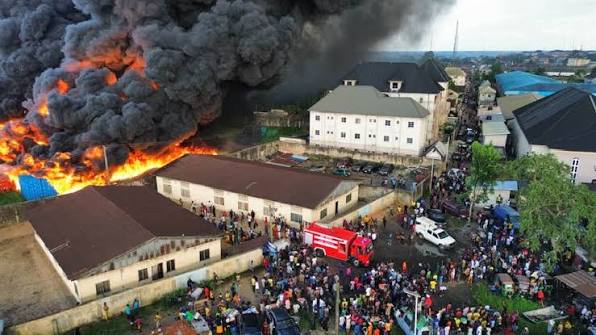

Nigerian Breweries Plc has confirmed that no casualties were recorded following a fire incident at an external warehouse facility in Aba, Abia State, where empty plastic crates were stored. The company disclosed this in a corporate filing signed by its Company Secretary, Uaboi Agbebaku, and released to the Nigerian Exchange Ltd. on Friday, assuring that operations at its Aba brewery, including production, logistics and sales, remained stable and unaffected.
The incident occurred on Thursday at a leased warehouse located opposite the Aba brewery, a facility used exclusively for storing empty plastic crates. According to the company, the fire was promptly contained through the coordinated efforts of its emergency response team, with support from relevant government agencies. The company also acknowledged the assistance of partners, including Oris Group and members of the host community, in managing the situation.
The Aba Fire Service Commander, Mr Belenta Belenta, confirmed to the News Agency of Nigeria that the source of the fire has yet to be ascertained. He noted that brewery staff appeared confused as to how the beer crates caught fire, as they were packed in an open field on the company’s premises and not close to any power source. The fire raged for hours, causing panic around the company’s neighbourhood, though the commander expressed relief that there were no casualties.
From an operational and investor relations perspective, Nigerian Breweries’ swift communication through the Nigerian Exchange demonstrates sound crisis management and transparency. The company’s immediate confirmation that production, logistics and sales remained unaffected would have reassured investors concerned about potential supply chain disruptions. The beer manufacturing sector operates on tight logistics schedules, and any interruption to crate availability could affect distribution, particularly in a major commercial hub like Aba, which serves the South-East market.
The incident also highlights the importance of warehouse safety standards, especially for facilities storing flammable materials such as plastic crates. While empty crates are not inherently hazardous, their density and stacking can contribute to rapid fire spread if ignition occurs. The company’s statement that a detailed assessment and investigation into the cause of the fire are ongoing suggests a commitment to identifying root causes and preventing recurrence, which aligns with its stated commitment to maintaining the highest standards of safety and operational excellence.
The role of external partners in containing the fire, including the Federal Fire Service, Oris Group Fire Unit, and Valumbra Flour Mills Fire Unit, underscores the value of inter-corporate emergency coordination in industrial zones. In many Nigerian industrial clusters, individual companies maintain their own fire response capabilities, but major incidents often require mutual aid arrangements. The successful containment of this fire without escalation to the main brewery or surrounding residential areas reflects well on these collaborative protocols.
For the local community, the fire incident would have caused understandable concern, given the potential for industrial fires to escalate and affect nearby homes and businesses. The absence of casualties and the limitation of damage to empty crates rather than finished goods or production equipment is a favourable outcome. Nigerian Breweries’ acknowledgment of the host community’s assistance in managing the situation reinforces the importance of positive community relations for industrial operators.
The incident does not appear to have material financial implications for Nigerian Breweries, given the limited scope of damage to empty crates and the continuity of operations. However, the investigation’s findings will be watched by safety regulators and industry peers, as any identified systemic issue could prompt broader reviews of warehouse safety practices across the beverage manufacturing sector.