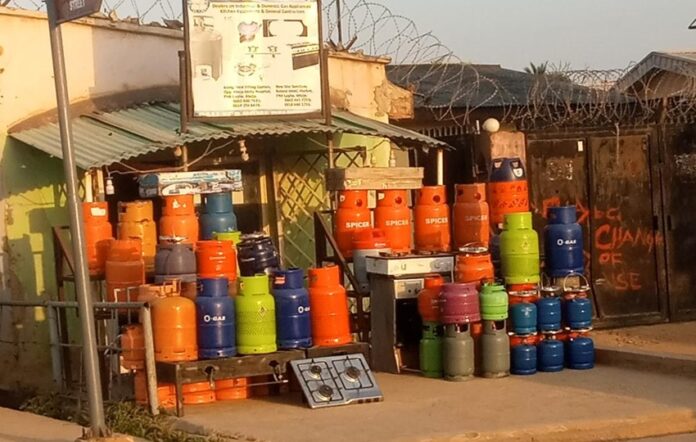

The Nigerian Association of Liquefied Petroleum Gas Marketers has stated that the recent rise in Liquefied Petroleum Gas prices is driven by supply constraints and global market pressures, with reduced local production and higher international benchmarks combining to push up costs for consumers nationwide. Mr Edu Inyang, NALPGAM President, made this known in an interview with the News Agency of Nigeria on Sunday in Lagos, attributing the increase to higher depot prices caused by reduced local supply and rising international benchmarks.
Inyang explained that lower volumes from the Dangote Refinery had impacted domestic supply, making product access more difficult for marketers. “Obtaining the product has become increasingly difficult, with allocations no longer as frequent as before,” he said. According to him, some off takers are unable to secure supplies for extended periods, while those with access are responding to prevailing demand conditions. He added that supplies from the Nigeria LNG Limited were also coming at higher costs, further pushing up depot prices nationwide.
From an economic perspective, LPG price increases have direct consequences for household welfare and business operations. Cooking gas is a basic necessity for millions of Nigerian households, particularly in urban areas where kerosene and firewood are less common. When LPG prices rise, families must either spend a larger share of their income on cooking fuel or switch to cheaper but less convenient or more polluting alternatives such as charcoal or firewood. For small businesses such as restaurants, bakeries, and food vendors that rely on LPG, higher input costs compress profit margins and may force price increases for customers.
Inyang linked the trend to developments in the global energy market, noting that international price movements continued to influence domestic pricing. “Nigeria is not insulated from global energy shocks. Developments in the international market inevitably affect local LPG prices,” he said. He noted that reliance on imported inputs and foreign exchange dynamics also contributed to rising costs. Nigeria produces LPG domestically, but a significant portion of supply still depends on imported components or is priced with reference to international benchmarks, making the domestic market vulnerable to global price shocks.
The association president noted that depot operators factor in landing and operational costs, which are reflected in retail prices. “Private depot operators cannot sell below their landing and operational costs, and this ultimately impacts the final price to consumers,” he said. This statement highlights the structural constraints on LPG pricing in Nigeria. Unlike subsidised products such as petrol, LPG operates in a largely deregulated market where prices reflect supply and demand conditions. When costs rise at the depot level, those increases are passed through the value chain to end users.
The Dangote Refinery’s reduced supply is particularly significant because the facility was expected to stabilise domestic LPG prices by providing a reliable source of locally produced product. If the refinery is not operating at full capacity or is prioritising other products such as petrol and diesel, the anticipated price moderation effect may not materialise. For LPG marketers, the unpredictability of supply from major producers makes business planning difficult, as they cannot guarantee that they will have product to sell or that their costs will be stable.
Inyang expressed optimism that increased investment in gas infrastructure would improve supply. “We have experienced similar cycles before. With the right investments, supply will improve and prices will stabilise,” he said. He called for the development of more gas processing plants and greater private sector participation to boost domestic production, adding that improved output from existing and upcoming gas projects would help stabilise the market and moderate prices. This call reflects a recognition that Nigeria’s gas sector has significant untapped potential, but realising that potential requires investment in processing, storage, and distribution infrastructure.
The cyclical nature of LPG price spikes, as noted by Inyang, suggests structural problems that have not been resolved despite repeated episodes. Each cycle typically follows a pattern: international prices rise or domestic supply falls, leading to price increases, consumer hardship, and political pressure. Temporary measures such as price caps or subsidies may be introduced, but these often distort the market without addressing underlying supply constraints. The solution, as Inyang suggests, lies in increasing domestic production capacity to reduce exposure to global market volatility.
For consumers, the immediate outlook is uncertain. Global energy markets remain volatile due to geopolitical tensions, and domestic supply constraints may persist until the Dangote Refinery and other producers stabilise operations. The federal government’s broader energy transition agenda, which includes promoting LPG as a cleaner cooking fuel compared to biomass, faces headwinds if prices remain high. Households that might otherwise switch from firewood or kerosene to LPG may delay the transition if cooking gas becomes unaffordable, with consequences for public health and environmental sustainability.