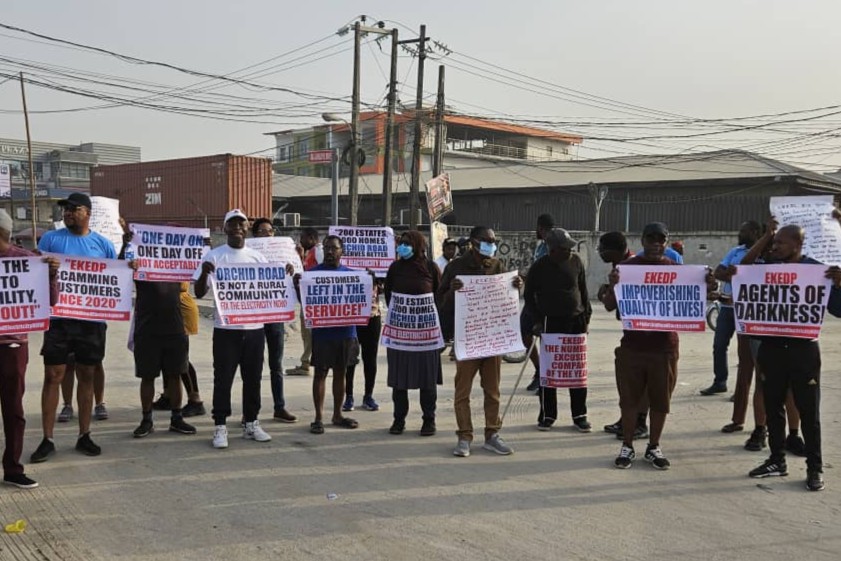

Residents under the Lekki Estate and Residents Stakeholders Association on Monday engaged the leadership of Eko Electricity Distribution Company to address persistent electricity supply challenges within the Lekki corridor, with discussions focused on identifying key distribution problems and exploring practical solutions to improve service delivery.
The engagement comes at a time when reliable grid power has become increasingly critical for households and businesses, following recent hikes in petrol prices that have made generator usage more expensive. LERSA President Sulyman Bello said the need to improve electricity supply had become more urgent due to geopolitical tensions in the Middle East driving up global oil prices and, consequently, local fuel costs.
“We are here to solve the problem of power and its availability. We are not going to dwell too much on the errors of the past but focus on the challenges facing the area in order to find solutions,” Bello stated. “People who ordinarily would run generating sets are now finding it difficult, which is why the power provided by EKEDC remains the best option for our circumstances.”
LERSA Power Committee Chairman Obi Isiuwa listed areas experiencing electricity supply challenges, including Joseph Avenue, Mohammed Yinka Bello Crescent in Onigbongbo Town, Sangotedo, Southern Estate Lakowe Phase II, Abijo GRA, Sea Side Estate in Ajah, Crown Estate, and several others. He identified inadequate transformers, frequent breakdown of injection feeders, voltage fluctuations, ageing distribution infrastructure, and intermittent tripping as the primary challenges.
Responding, EKEDC Deputy Chief Executive Officer Olumide Jerome said the company had committed billions of naira towards improving electricity distribution and infrastructure within its network. He disclosed that about 100 transformers were available for deployment to areas with critical needs, adding that the company would commission new feeders, replace faulty panels, and complete ongoing injection substation projects.
Jerome, however, noted that where properties had been redeveloped from residential buildings into high-rise structures, hotels, or other energy-intensive facilities, developers should provide private transformers rather than depend on public ones to avoid overloading existing infrastructure.
Head of Projects Department Angela Ukhokhoakhe detailed completed initiatives, including the rehabilitation of 26 feeders, commissioning of four new feeders, and completion of the NTDA Injection Substation with two 33kV feeders and three 11kV feeders. She said the company had replaced a 15MVA transformer at Maroko Injection Substation, replaced obsolete 11kV panels at several substations, and retrofitted the T2 15MVA transformer at Victoria Garden City Injection Substation.
Ukhokhoakhe added that an additional 15MVA transformer at Lekki Injection Substation was awaiting commissioning, while 16 feeder rehabilitation projects were ongoing. The company is also upgrading 11 units of 300kVA transformers to 500kVA capacity and upgrading the Agungi Injection Substation from 1x15MVA to 2x15MVA.
The engagement reflects growing pressure on distribution companies to improve service delivery as economic conditions make alternative power sources increasingly unaffordable for residents and businesses. For the Lekki corridor, which hosts significant commercial activity and residential investment, reliable electricity supply is essential to sustaining economic growth and maintaining property values.