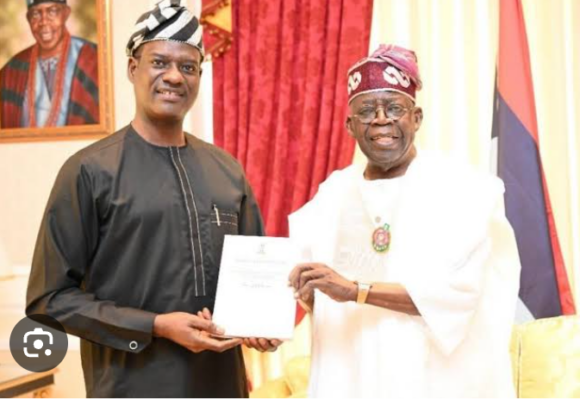

President Bola Tinubu on Monday swore in Taiwo Oyedele as Minister of State for Finance, tasking the tax policy expert with supporting efforts to strengthen fiscal coordination and advance the administration’s economic reform agenda. The ceremony at the Presidential Villa in Abuja formalised Oyedele’s elevation from chair of the Presidential Committee on Fiscal Policy and Tax Reforms to a cabinet position, placing the architect of Nigeria’s most ambitious tax overhaul in recent history at the heart of policy implementation.
Tinubu described the appointment as a strategic decision aimed at reinforcing the government’s capacity to manage fiscal policy during a delicate economic transition. He praised Oyedele’s role in reviewing Nigeria’s tax system, characterising his work as critical to modernising a framework that had become obsolete and misaligned with progressive economic thinking. The president noted that Oyedele’s dedication and determination made him suitable for the responsibility, stating that it did not take much to decide where he fit within the administration’s structure.
The new minister assumes office at a moment when fiscal policy faces competing pressures. Revenue mobilisation remains a central objective of the Tinubu administration, with the Federal Inland Revenue Service pursuing aggressive collection targets while the new Value Added Tax sharing formula directs enhanced resources to state governments. Oyedele’s committee work, which proposed harmonisation of multiple taxes and streamlined compliance procedures, has been widely embraced by the organised private sector as a necessary correction to a historically fragmented fiscal landscape.
Tinubu acknowledged the magnitude of the task ahead, noting that Oyedele would face significant responsibilities in managing fiscal policy at a time when economic stability is being experienced without exponential growth. The president’s characterisation captures the current macroeconomic reality: inflation has moderated from previous peaks, the naira has stabilised following exchange rate unification, but GDP growth remains below the levels required to make a meaningful dent in unemployment and poverty.
Oyedele’s professional background provides a foundation for navigating these challenges. The economist and accountant spent 22 years at PwC, rising to become Africa Tax Leader, and holds academic appointments at Babcock University and Lagos Business School. His deep familiarity with multinational corporate taxation positions him to address long-standing investor grievances about multiplicity of levies and unpredictable fiscal treatments. The private sector response to his nomination has been broadly positive, reflecting confidence that a technocrat with implementation experience now holds a line ministry role.
The appointment also reinforces continuity in the administration’s reform trajectory. Oyedele’s committee outputs have already shaped policy direction, including proposed changes to tax administration and compliance enforcement. His elevation suggests the president intends not merely to propose reforms but to drive their administrative embedding within the federal bureaucracy. This matters for investor confidence, which responds to signals that policy announcements will translate into sustained implementation rather than episodic interventions.
For the Ministry of Finance, Oyedele’s arrival adds specialised capacity at a time when coordination with the Central Bank of Nigeria, the Budget Office, and state governments is essential. Fiscal-monetary policy alignment has improved under the current CBN leadership, but maintaining that coherence requires continuous engagement across institutions. The new minister’s experience navigating complex stakeholder environments, honed during his committee work and PwC tenure, should facilitate the kind of inter-agency collaboration that effective policy execution demands.