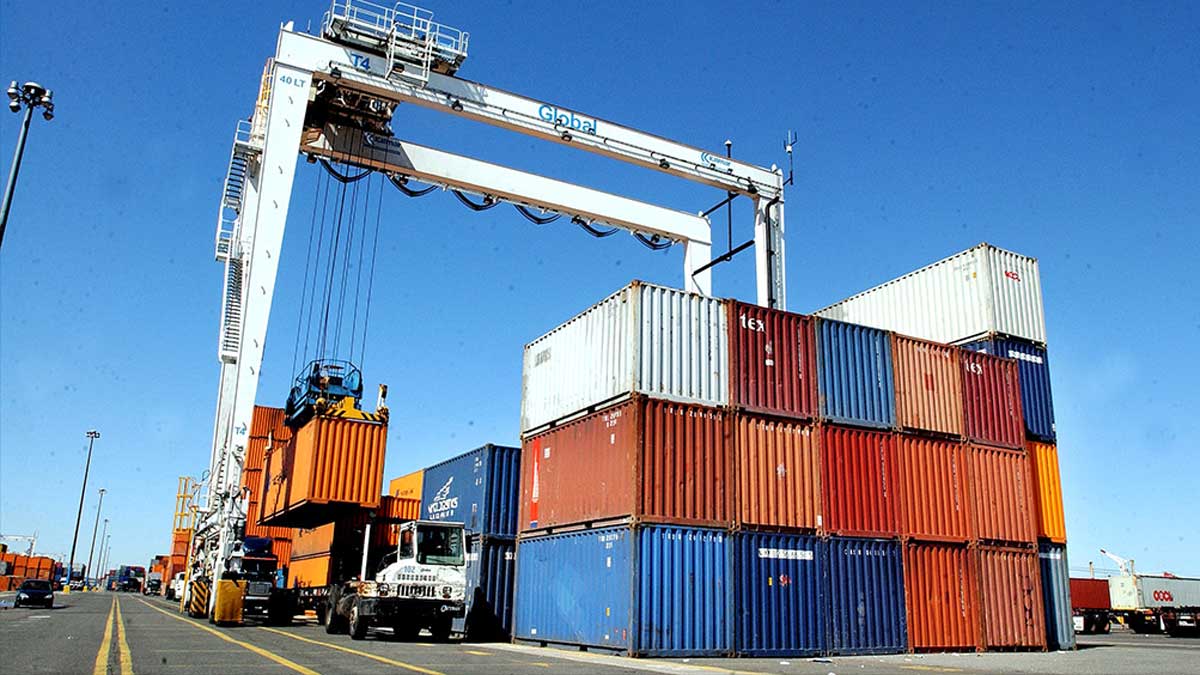

Nigeria maintained a merchandise trade surplus of N1.71 trillion in the fourth quarter of 2025, even as total trade activity declined, revealing underlying structural vulnerabilities beneath the headline figures. Data released on Tuesday by the National Bureau of Statistics shows total merchandise trade stood at N36.21 trillion, down 1.07 percent from N36.60 trillion in the same quarter of 2024 and 8.94 percent from the N39.77 trillion recorded in the previous quarter, reflecting weaker export activity, particularly in crude oil shipments.
Exports accounted for 52.36 percent of total trade during the quarter, valued at N18.96 trillion, while imports stood at N17.25 trillion, yielding the N1.71 trillion surplus. However, export earnings fell 5.25 percent from N20.01 trillion in Q4 2024 and declined 16.88 percent compared with N22.81 trillion in Q3 2025. This sequential decline suggests that while Nigeria remains a net exporter, the absolute value of what the country sells abroad is shrinking, a trend with significant implications for foreign exchange earnings and government revenue.
Crude Oil Dominance and Vulnerability
Crude oil remained the largest contributor to Nigeria’s exports, valued at N9.70 trillion, representing 51.17 percent of total exports. Other petroleum products added N6.12 trillion, or 32.25 percent, meaning that hydrocarbons together accounted for more than 83 percent of all export earnings. This concentration exposes Nigeria to the full force of global oil price volatility and production disruptions, leaving the economy perpetually vulnerable to external shocks.
The quarter’s export performance reflects this vulnerability. While prices remained relatively supportive, production challenges and infrastructure constraints limited Nigeria’s ability to capitalise on global demand. The country continues to struggle with oil theft, pipeline vandalism, and underinvestment that constrain output below technical capacity and OPEC quotas.
Agricultural goods brought in N1.32 trillion, while raw materials contributed N1.19 trillion. Smaller contributions came from manufactured goods at N423.43 billion, solid minerals at N116.84 billion, and energy goods at N89.72 billion. These figures underscore the limited diversification of Nigeria’s export base and the significant work required to build non-oil sectors capable of generating substantial foreign exchange.
Import Composition Reveals Industrial Gaps
On the import side, manufactured goods accounted for the largest share, valued at N8.80 trillion, or 51.03 percent of total imports. This figure highlights Nigeria’s continued dependence on foreign-produced manufactured items, reflecting the limited competitiveness of domestic industries. From machinery and equipment to consumer goods, Nigerian demand is met largely by producers in Asia, Europe, and the Americas.
Other petroleum products followed with N4.02 trillion, representing the refined fuels that Nigeria continues to import despite domestic crude production. The Dangote Refinery’s operations are gradually reducing this dependence, but the import figures from Q4 2025 predate the full impact of local refining capacity.
Raw materials and agricultural goods stood at N2.35 trillion and N1.44 trillion respectively. Imports of crude oil totalled N499.75 billion, solid minerals N140.99 billion, and energy goods N80 million. The crude oil import figure, while significant, has declined as domestic refining capacity has increased.
Economic Implications
The N1.71 trillion surplus, while positive on its face, masks concerning trends. The sequential decline in both total trade and export earnings suggests that Nigeria’s external sector may be contracting, reducing the flow of foreign exchange into the economy. For an economy where the naira faces persistent pressure, any reduction in dollar inflows complicates exchange rate management and adds to inflationary pressures.
The surplus also reflects import compression as much as export strength. With domestic purchasing power constrained by inflation and currency depreciation, import demand may be softening, reducing the outflow of foreign exchange even as export earnings decline. This dynamic provides temporary balance but does not address the underlying need to grow export capacity.
For government revenue, the export composition matters critically. Oil exports generate federation account inflows through royalties, taxes, and NNPC remittances. A decline in export earnings translates directly into reduced fiscal resources, potentially widening budget deficits or forcing expenditure cuts. Non-oil exports, while growing, remain too small to compensate for hydrocarbon revenue shortfalls.
Structural Challenges and Policy Implications
The trade data reinforces the urgency of economic diversification efforts. While successive governments have articulated the goal of expanding non-oil exports, progress remains limited. Agricultural exports, at N1.32 trillion, represent less than 7 percent of total exports, far below the sector’s potential given Nigeria’s arable land and agricultural workforce.
Manufactured goods exports, at just N423.43 billion, highlight the competitive challenges facing Nigerian industry. High energy costs, infrastructure deficits, and regulatory friction combine to raise production costs, making it difficult for domestic manufacturers to compete in regional and global markets. Addressing these structural constraints is essential for building an export base that can support sustainable growth.
The import composition also carries policy implications. The dominance of manufactured goods in Nigeria’s import bill suggests opportunities for import substitution, where domestic industries could potentially capture market share. However, successful import substitution requires competitive production, which in turn demands improvements in infrastructure, access to finance, and regulatory efficiency.
For Nigerian businesses, the trade data provides context for strategic planning. Export-oriented enterprises face headwinds from global competition and domestic constraints, but also opportunities in regional markets where Nigerian goods may find preferential access under ECOWAS and AfCFTA arrangements. Import-dependent businesses must navigate currency volatility and foreign exchange availability, managing risks through hedging and supply chain diversification.
The Q4 2025 trade figures offer a snapshot of an economy in transition, still heavily dependent on oil, still importing manufactured goods, but generating a surplus that provides some buffer against external pressures. The path to sustainable growth lies in transforming this structure, building export capacity across multiple sectors, and reducing the vulnerabilities that leave Nigeria perpetually exposed to global commodity cycles.