
Dangote Petroleum Refinery has implemented its fourth fuel price adjustment since March 2, raising ex-depot prices for petrol and diesel as rising global oil costs and market dynamics exert pressure on Nigeria’s downstream sector. The new pricing template, shared with marketers, increases Premium Motor Spirit (petrol) to N1,175 per litre from N995, while Automotive Gas Oil (diesel) now sells at N1,620 per litre, up from N1,430.
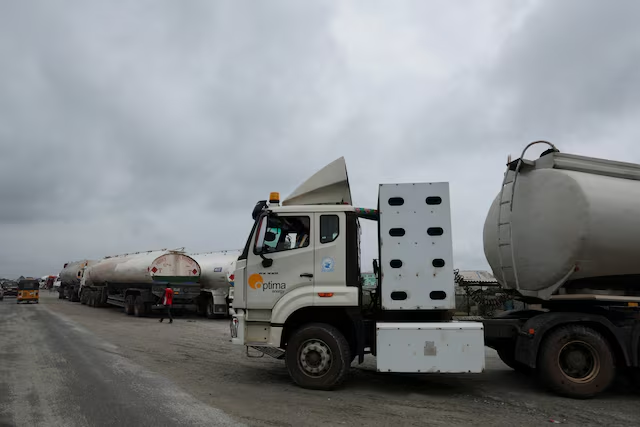
The price changes followed a temporary pause in petrol loading and limited truck-out activities at the refinery, which had already sparked speculation of an imminent adjustment among industry observers. The refinery’s pricing decisions carry significant weight across the downstream sector, as its gantry prices often influence depot rates nationwide, and marketers are expected to adjust their own prices accordingly, potentially pushing fuel costs higher across the country.
The adjustments reflect the direct pass-through of global oil market dynamics to Nigerian consumers. Brent crude is trading above $102 per barrel, while West Texas Intermediate hovers around $101, driven by escalating Middle East tensions and supply disruptions through the Strait of Hormuz. For a country that remains a net importer of refined petroleum products despite the Dangote Refinery’s operations, higher crude prices translate directly into increased landing costs and ultimately higher pump prices.
The frequency of adjustments—four since March 2—signals the volatility of current market conditions and the sensitivity of Nigeria’s deregulated downstream sector to global price movements. Under the previous subsidy regime, such fluctuations would have been absorbed by the state, masking their impact on consumers. In the fully deregulated market, they are passed through directly, creating immediate price signals that affect household budgets and business operating costs.
For Nigerian households, each price increase compounds existing inflationary pressures. Petrol is not only a direct consumption good but an input into transportation costs that affect virtually all goods and services. When fuel prices rise, transport operators pass costs to passengers, traders pass costs to consumers, and manufacturers pass costs to buyers. The multiplier effect means that the N180 per litre increase at the gantry translates into broader price increases across the economy.
For businesses, diesel price increases are particularly painful. Diesel powers generators for the vast majority of Nigerian enterprises, from small shops to large manufacturers, given the unreliable grid supply. Each N190 per litre increase in diesel prices raises operating costs, squeezes margins, and potentially forces businesses to raise their own prices, contributing to the inflationary cycle.
The timing of the increases is particularly challenging given the broader economic context. Inflation, while moderating from peaks above 30 percent, remains elevated. The Central Bank of Nigeria has maintained a tightening stance to combat price pressures, but fuel price increases driven by external factors operate outside monetary policy control, potentially complicating the bank’s efforts.
The Dangote Refinery, which began operations with the promise of reducing Nigeria’s dependence on imported refined products and insulating the economy from global price volatility, now finds itself transmitting global price shocks to domestic consumers. While the refinery does reduce the volume of imports, it cannot escape the fundamental reality that crude oil is a globally traded commodity, and its price determines the cost of refined products regardless of where refining occurs.
The experience underscores the importance of completing the transition to full domestic refining capacity while also developing the crude oil production capacity to supply it. Nigeria currently produces below its OPEC quota, limiting the volume of crude available for domestic processing. Increasing production would enable more refining, reduce import dependence, and potentially moderate domestic price movements by creating a more integrated domestic value chain.
For Nigerian consumers and businesses, the immediate reality is continued fuel price volatility. As long as global oil markets remain turbulent and Nigeria’s downstream sector remains exposed to international prices, pump prices will fluctuate with global events. The Dangote Refinery’s pricing adjustments are not a cause of this volatility but a transmission mechanism. Addressing the underlying vulnerability requires completing the journey to full domestic refining sufficiency and crude production capacity that can supply it.