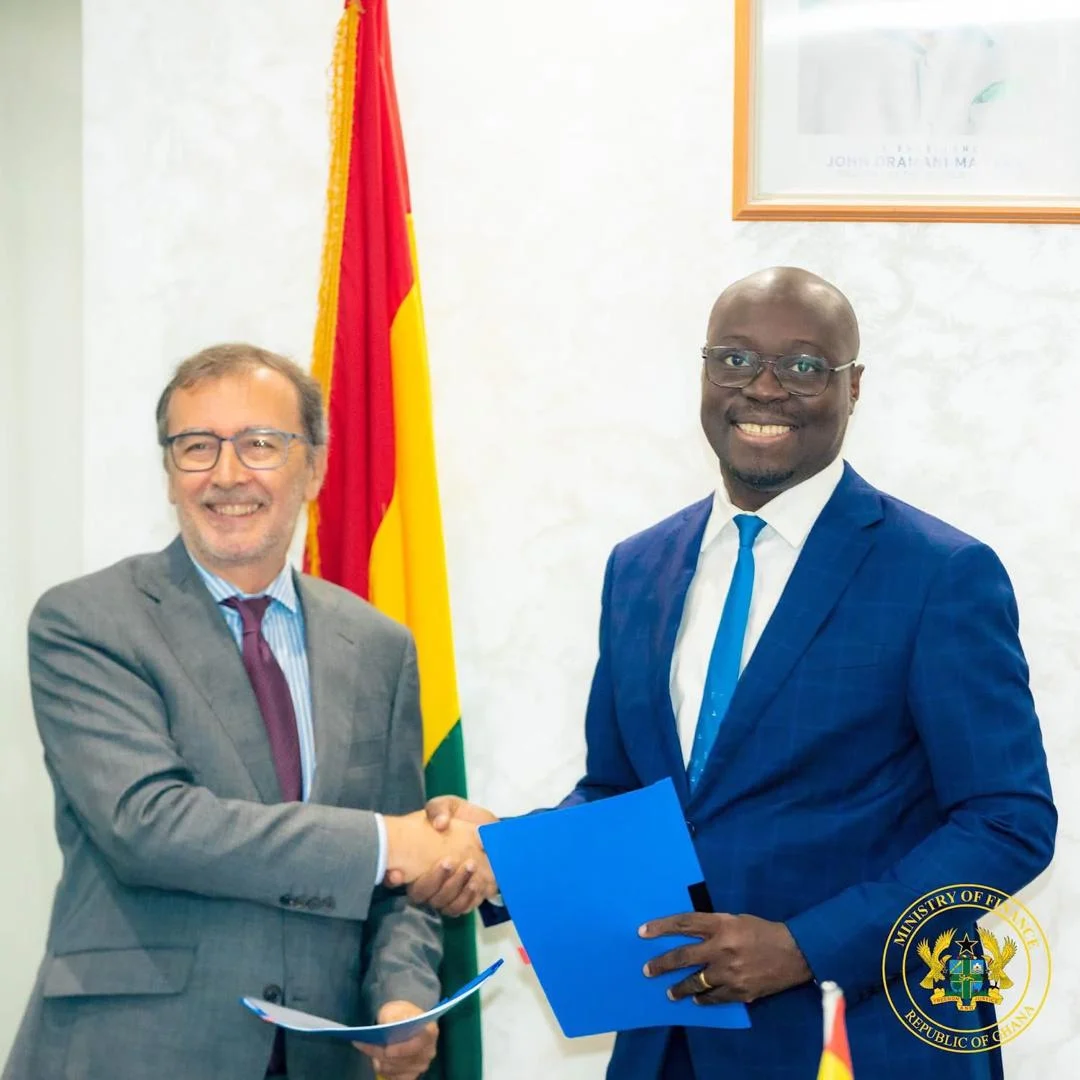

Ghana has signed a Bilateral Debt Restructuring Agreement with the Kingdom of Spain, marking another milestone in its efforts to restore debt sustainability and stabilise the economy after years of financial distress. The deal, the fifth concluded under Ghana’s official creditor framework, reflects growing international confidence in the country’s ongoing reforms and commitment to responsible debt management.
Finance Minister Dr Cassiel Ato Forson signed the agreement on behalf of Ghana, while the Spanish Ambassador to Ghana, H.E. Ángel Lossada Torres-Quevedo, represented Spain at a ceremony in Accra. The signing was also witnessed by Ghana’s Minister of Health, Kwabena Mintah Akandoh, and officials from both finance ministries, underscoring the agreement’s broader implications for bilateral development cooperation. The new arrangement with Spain follows similar restructuring agreements reached earlier this year with the China Exim Bank, France, Finland, and the United Kingdom, all part of Ghana’s Official Creditor Committee under the G20 Common Framework for debt treatment. The framework was designed to help heavily indebted countries manage unsustainable obligations while preserving access to essential development financing.
Ghana, one of Africa’s fastest-growing economies before the COVID-19 pandemic, experienced a severe debt crisis in 2022 as high borrowing costs, a depreciating cedi, and global inflation pressures undermined its fiscal position. The country defaulted on most of its external debt that year and subsequently sought debt relief to unlock further support from the International Monetary Fund (IMF).
Under the IMF’s $3 billion Extended Credit Facility, Ghana has committed to restoring debt sustainability, cutting the fiscal deficit, and improving transparency in public finance. The restructuring of bilateral and commercial debts has been a critical condition for continued IMF disbursements. The Spanish deal, therefore, marks a significant step toward clearing the path for the next phase of Ghana’s economic recovery.
Speaking at the signing ceremony, Dr Forson reaffirmed the government’s determination to complete all remaining restructuring processes before the end of the year, saying this would “put this difficult chapter behind the nation.” He described the agreement as an important step in building a more resilient economy anchored on fiscal discipline, growth-oriented reforms, and sustainable debt management. “Today’s signing represents another vote of confidence in Ghana’s recovery plan,” Dr Forson said. “We are working tirelessly to ensure that every restructuring process under the Common Framework is concluded swiftly and transparently. This will enable us to focus fully on economic transformation and improving the living standards of our people.”
Ambassador Torres-Quevedo, in his remarks, praised Ghana’s progress under its reform agenda and reaffirmed Spain’s commitment to strengthening economic cooperation between the two countries. “This agreement is not only about resolving past debt but also about opening a new and stronger phase in Spain–Ghana relations,” he said. “Spain remains committed to supporting Ghana’s development priorities, particularly in health, renewable energy, and digitalisation.”
The Spanish envoy highlighted Ghana’s potential as a strategic partner in West Africa, citing its relative political stability and ongoing economic diversification efforts. He added that Spain is exploring deeper collaboration in trade, energy, and technical assistance to bolster Ghana’s long-term growth.
The debt restructuring with Spain is expected to provide fiscal space for Ghana’s government, allowing it to redirect funds toward social investment, healthcare, and infrastructure. The presence of the Health Minister at the signing event also reflected the importance of debt relief in safeguarding social spending at a time when the government faces competing fiscal demands.
Economic analysts say the deal will contribute to reducing Ghana’s external debt burden, which stood at about $30 billion as of mid-2025, and could improve investor sentiment as the government works to restore market access. The country is also negotiating with private bondholders to restructure $13 billion in Eurobond debt, a process expected to conclude in the coming months.
Ghana’s engagement with its creditors has been closely watched across Africa, as other countries — including Zambia and Ethiopia — navigate similar debt restructuring challenges. Successful completion of Ghana’s programme could serve as a model for balancing fiscal recovery with growth imperatives under the Common Framework.
For now, the government’s focus remains on consolidating macroeconomic gains achieved under the IMF programme, stabilising the exchange rate, and reducing inflation, which has been on a downward trend after peaking at over 50% in early 2023.
“The agreements we are signing are not just about debt; they are about restoring credibility and creating a pathway for sustainable prosperity,” Dr Forson said. “We are determined to make the most of this opportunity to rebuild trust, restore stability, and set Ghana on a firm growth trajectory.”
With the Spanish deal now concluded, Ghana moves closer to completing its bilateral restructuring roadmap — a key milestone toward exiting its debt crisis and charting a course for renewed economic confidence.