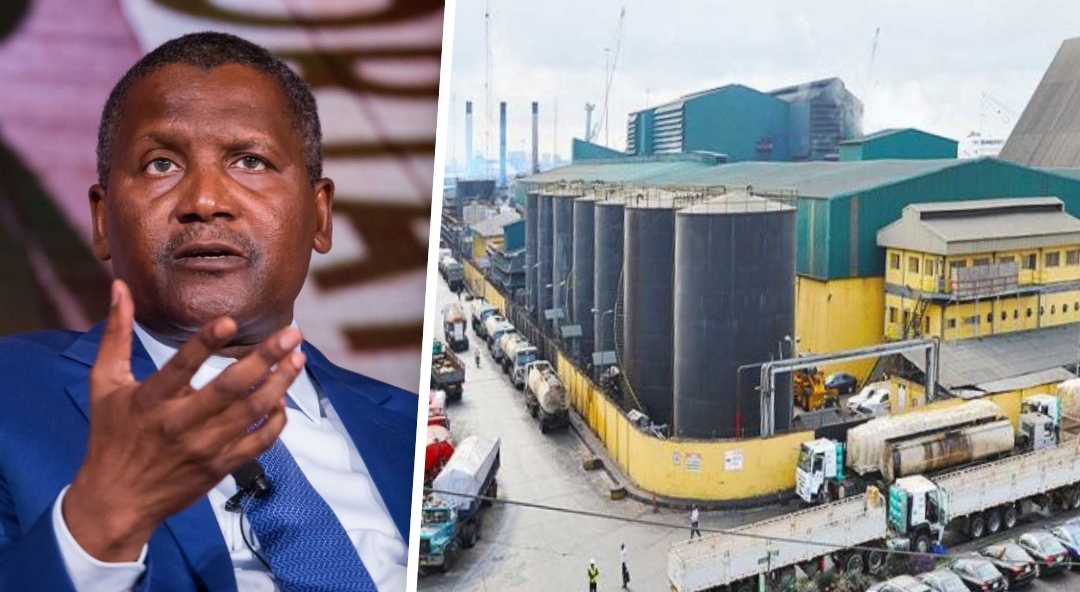

Dangote Sugar Refinery has posted a dramatic improvement in its 2025 financial results, cutting its net loss by 73 percent to N64.1 billion ($41.7 million) compared to the N192.6 billion ($125.2 million) loss recorded in the previous year. The Lagos-based sugar refiner saw revenue surge by 51 percent to N665.6 billion ($432.6 million), up from N441.5 billion ($287 million) in 2024, according to audited financial statements released this week.
The sharp reduction in losses comes after two turbulent years during which Nigeria’s currency crisis severely impacted the company’s bottom line. Pre-tax losses also narrowed significantly to N72.3 billion ($47 million) from N270.9 billion ($176.1 million) in 2024, demonstrating what analysts describe as a company learning to navigate challenging macroeconomic conditions.
The most striking improvement appeared in the company’s gross profit figures, which jumped from just N31.1 billion ($20.2 million) in 2024 to N122.6 billion ($79.7 million) in 2025. This nearly fourfold increase signals that Dangote Sugar is successfully reclaiming pricing power after two years of intense margin compression.
Management responded to higher input costs by adjusting prices upward, and consumer demand remained resilient. Crucially, the cost of sales grew at a slower pace than revenue, allowing gross margins to expand considerably. This operational leverage suggests the company is emerging from the worst of the inflationary pressures that had plagued its performance since mid-2023.
How Nigeria’s Currency Devaluation Broke the Business Model
The losses that hammered Dangote Sugar in 2024 trace directly to Nigeria’s exchange rate liberalization in June 2023. When the Central Bank of Nigeria unified the exchange rate windows, the naira collapsed from approximately 460 to the dollar to nearly 1,500 by February 2024.
For Dangote Sugar, which relies heavily on imported raw sugar priced in dollars while selling finished products in naira, the devaluation created a perfect financial storm. Dollar-denominated raw material costs skyrocketed overnight. Letters of credit used to finance hard currency working capital ballooned. Finance charges exploded as exchange losses accumulated on foreign currency obligations.
The 2024 loss of N192.6 billion was predominantly a foreign exchange story, with finance costs reaching N210.5 billion ($136.8 million), much of it attributable to currency losses on outstanding obligations.
Finance Costs Cut Nearly in Half as Naira Stabilizes
In a significant development for 2025, finance costs fell to N110.3 billion ($71.7 million), representing a reduction of nearly 48 percent from the previous year. The decline reflects both a relative stabilization of the naira and aggressive efforts by management to reduce the company’s foreign exchange exposure.
The improvement in finance costs alone accounts for a substantial portion of the overall recovery, demonstrating how sensitive Dangote Sugar’s profitability remains to currency movements. With the naira trading within a narrower range during 2025 compared to the chaotic devaluation period of 2023-2024, the company has been able to better forecast and manage its hard currency obligations.
The financial statements reveal a company still carrying significant leverage but making incremental progress. Total assets stood at N965.9 billion ($627.8 million), with property, plant and equipment valued at N613.4 billion ($398.7 million), reflecting substantial ongoing capital investment in the company’s backward integration projects.
Total liabilities decreased modestly to N836.9 billion ($543 million) from the prior year, leaving shareholders’ equity of N128.9 billion ($83.8 million). Borrowings remained heavy at N684.4 billion, though this represents a slight reduction from N717.6 billion in 2024. Cash and equivalents improved markedly to N59.7 billion from N32.2 billion, providing greater liquidity flexibility.