


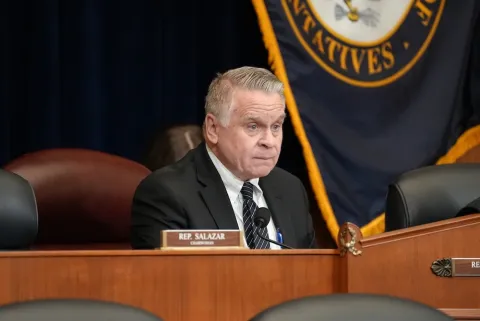

A prominent United States lawmaker has criticized the Federal Government of Nigeria for spending $9 million on a Washington-based lobbying firm, DCI Group, to improve its international image. Speaking during a recent hearing on religious freedom, Representative Chris Smith, Chairman of the House Foreign Affairs Subcommittee on Africa, argued that the move reflects a persistent “culture of denial” among Nigerian officials regarding systemic human rights and religious liberty concerns. For the Nigerian economy, this development underscores the high “reputational cost” of governance challenges, where significant public funds are diverted toward image laundering rather than addressing the root causes of insecurity and social friction.
The economic consequence of this lobbying deal is a direct drain on Nigeria’s scarce foreign exchange reserves. At a rate of $750,000 per month, the $9 million contract represents a significant fiscal commitment to “K-Street” lobbyists at a time when Nigeria faces severe revenue constraints and a widening budget deficit. Beyond the immediate cash outflow, the public criticism from US lawmakers increases the “political risk premium” for Nigeria. Such high-profile rebukes signal to institutional investors and global credit agencies that the government is prioritizing optics over structural reforms, which can dampen Foreign Direct Investment (FDI) and complicate bilateral trade negotiations.
Analytically, the controversy centers on the effectiveness of “reputation management” versus “substantive reform.” The US hearing highlighted that despite the hired firm’s efforts to frame Nigeria as a protector of religious rights, lawmakers like Smith remain focused on reports from organizations like Genocide Watch, which described the country as a “killing field.” From a diplomatic perspective, this disconnect suggests that lobbying alone cannot bridge the gap between Nigeria’s domestic reality and international expectations. For the Nigerian treasury, this raises a question of “Return on Investment” (ROI): if multi-million dollar contracts fail to prevent negative designations or legislative criticism, the expenditure becomes a sunk cost with no tangible benefit to the nation’s sovereign standing.
The impact on Nigeria’s relationship with the US Executive and Legislative branches is another critical dimension. The US lawmakers noted that Nigerian billionaires are also entering the lobbying fray, with one recently signing a $120,000-a-month contract with Valcour Global Public Strategy to influence Congress. This “privatization of diplomacy” can create fragmented narratives and further confuse international partners. For the Nigerian business community, a strained relationship with the US government driven by concerns over religious freedom and human rights could lead to more stringent “Country of Particular Concern” (CPC) designations, potentially triggering sanctions or restrictions on certain types of military and developmental assistance.
Furthermore, the “culture of denial” mentioned by the lawmaker points to a deeper institutional challenge. Instead of utilizing these funds to strengthen the Nigerian Human Rights Commission or improve the transparency of security operations, the state is perceived as buying “talking points.” This approach undermines the Renewed Hope agenda’s promise of accountability. For the economy to thrive, investors need to see a government that acknowledges and fixes systemic issues, rather than one that attempts to “narrate away” the problems. True economic stability is built on the foundation of the Rule of Law, not on the efficiency of public relations firms in Washington DC.
The long-term economic outlook for Nigeria hinges on its ability to align its domestic human rights record with its global economic ambitions. As Nigeria seeks to become a leading player in the global “Experience Economy” and attract international tourists and tech giants, its reputation for safety and justice is its most valuable asset. The $9 million spent on lobbying could have been more effectively deployed in community policing, judicial reform, or human rights education. By moving away from a “culture of denial” and embracing transparent governance, Nigeria can secure its position as a reliable partner in the global marketplace, ensuring that its wealth is used to build the nation rather than polish its image.


