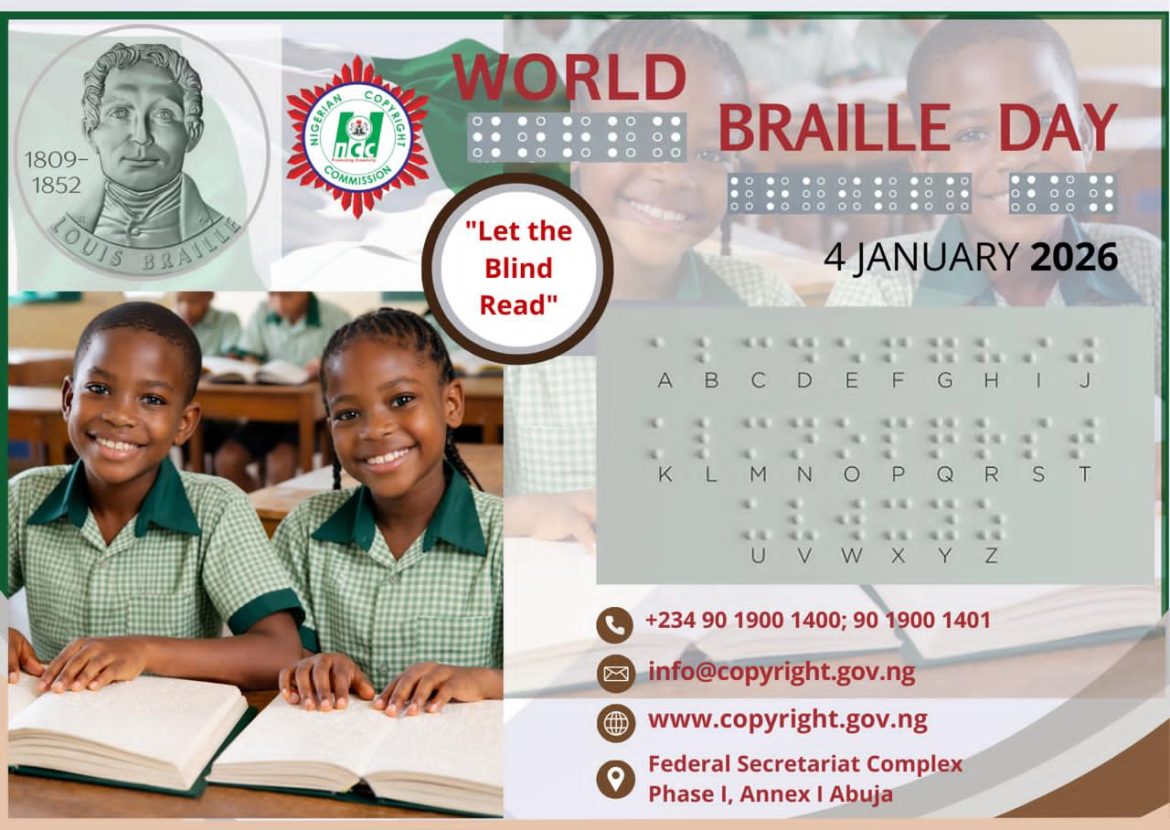

On Sunday, Nigeria’s copyright regulator marked World Braille Day with a strong pledge to make the country’s copyright system more inclusive and accessible for people who are blind or have print disabilities. The Nigerian Copyright Commission (NCC) said it wants a system that protects authors’ rights while also ensuring that learning materials are available in formats beyond traditional print.
World Braille Day, observed every 4 January, celebrates the life and legacy of Louis Braille, the French educator who developed the tactile reading and writing system used by people with visual impairments. The day highlights the importance of literacy and accessibility for millions of people around the world.
At the heart of the NCC’s message was a clear demand: “Let the blind read.” In a statement to mark the day, the Director-General of the Commission, Dr John Asein, reaffirmed the organisation’s commitment to a copyright framework that serves not only creators and markets, but also learners, students and readers with print disabilities. He stressed that access to knowledge should be treated as a right, not a privilege.
Dr Asein acknowledged that, despite progress in other areas, the availability of accessible materials remains very low in Nigeria. He cited studies showing that less than one per cent of published books are available in formats such as Braille, audio recordings or digital text that can be used with screen-reading technology. He described this scarcity as a serious “book famine” that limits access to education, employment and full participation in society for blind and visually impaired people.
The NCC pointed to recent changes in Nigeria’s copyright law as a key step towards greater inclusion. The Copyright Act of 2022, which came into force in recent years, incorporates part of the Marrakesh Treaty into Nigerian law. This allows for the reproduction, distribution and cross-border exchange of works in accessible formats for people with print disabilities.
Dr Asein highlighted that the new Act also offers legal protections, known as safe-harbour provisions, for authorised bodies involved in producing and sharing accessible copies of works. The aim is to provide clarity and confidence to publishers, libraries and other stakeholders so they can take part in expanding access without fear of legal issues. To support this, the Commission has issued fresh guidelines designed to strengthen the safe-harbour system, promote transparency and encourage broader participation.
The NCC said these efforts would be supported by ongoing advocacy, awareness-raising and training for publishers, educational institutions and other groups. The goal is to build the capacity of organisations across the book value chain so that more content can be adapted into accessible forms.
Dr Asein said that celebrating Braille is not simply symbolic. It should serve as a reminder that inclusion is a legal duty and a moral imperative. He urged stakeholders to take meaningful action that will improve the lives of people with visual impairments and ensure they are not left behind in Nigeria’s educational and economic growth.
The NCC’s statement reinforces a broader call for inclusive policies and practical steps to reduce barriers faced by blind and visually impaired citizens, particularly in a world that increasingly depends on digital access and information.