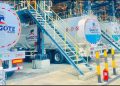




Babcock University has unveiled plans to expand its independent electricity generation capacity through solar and gas-powered systems as it moves to achieve uninterrupted, round-the-clock power across its campuses.
The university’s President and Vice-Chancellor, Professor Afolarin Ojewole, announced the initiative on Friday, November 27, 2026, during a press briefing at the main campus in Ilishan-Remo, Ogun State, to mark his first year in office.
According to Ojewole, the institution requires approximately five megawatts (MW) to meet its operational demand, while its existing Independent Power Plant (IPP) generates about 1.2MW, leaving a 3.8MW generation deficit.
Bridging that shortfall currently costs the university hundreds of millions of naira to sustain supply for most hours of the day, according to a report by The Punch on Saturday, November 28. To ease this financial burden and reduce reliance on the Ibadan Electricity Distribution Company (IBEDC) and the national grid, management has begun deploying solar systems in critical facilities, including administrative offices and the main library.
Alongside the initial solar rollout, the university is evaluating a larger off-grid expansion utilizing either gas turbines or utility-scale solar arrays. Ojewole noted that management has already interviewed more than a dozen prospective power providers to identify the most viable technical and commercial model, though no completion timeline or final technology choice has been announced.
Ojewole stressed that reliable energy is central to Babcock’s push for global competitiveness, particularly in sustaining academic research, digital infrastructure, and clinical operations at its teaching hospital. Continuous power is also vital for campus security, which relies on more than 5,000 closed-circuit television cameras on the main campus and roughly 500 across another campus.
“Until there is 24-hour power on this campus, we will not rest,” he said, adding that students, lecturers, and researchers must be able to access academic facilities at any hour.
The push underscores a broader shift among Nigerian universities and large enterprises toward captive power generation as grid instability and high diesel costs strain operating budgets. For Babcock, closing its 3.8MW supply gap will stabilize campus operations and free up resources for long-term academic growth.