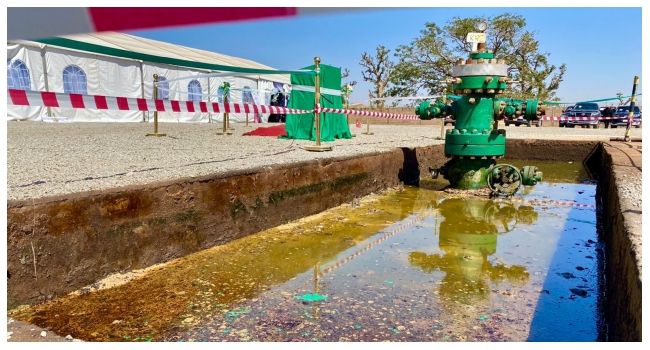

Gombe State expects oil exploration at the Kolmani oilfield, straddling the boundary between Gombe and Bauchi states, to resume in the first week of December 2026, renewing expectations around a flagship northern project that has suffered repeated interruptions without reaching commercial production. The state’s Commissioner for Energy and Mineral Resources, Sanusi Ahmad Pindiga, announced the new timeline on Monday, November 16, 2026, following a State Executive Council (SEC) meeting. While the state government framed the restart as part of preparations to position Gombe for oil and gas opportunities, NNPC Limited has yet to publicly confirm the December timetable.
Ahead of the anticipated resumption, Pindiga disclosed that Rift Oil Nigeria Limited, the consultant engaged to support Gombe’s institutional readiness for the petroleum sector, has completed 12 of its 14 planned assignments. Part of that groundwork includes a vocational empowerment programme that trained 100 graduates in plumbing, carpentry, information and communication technology, and welding, equipping them with starter kits and financial support to launch businesses tied to future industry demand.
The energy update came alongside major infrastructure approvals from the same November 16 SEC meeting, which was presided over by Governor Muhammadu Inuwa Yahaya. According to reports by Voice of Nigeria and Vanguard on November 17, the council approved seven road projects spanning roughly 97 kilometres across Yamaltu-Deba, Balanga, Shongom, and Kaltungo local government areas, alongside ₦3.8 billion for 40 emergency and public utility vehicles, comprising 20 firefighting trucks and 20 water tankers.
Long promoted as northern Nigeria’s gateway into the oil industry, the Kolmani prospect dates back to October 2019, when the then Nigerian National Petroleum Corporation announced the discovery of crude oil, gas, and condensates at the Kolmani River II Well at a depth of 13,701 feet. Former President Muhammadu Buhari subsequently flagged off the Kolmani Integrated Development Project on November 22, 2022, covering Oil Prospecting Licences 809 and 810 in the Gongola Basin with ambitious plans for refining, fertiliser production, gas processing, and power generation.
Four years after that flag-off, however, the project has still not transitioned into commercial production, and conflicting accounts have surrounded its recent stoppages. Speaking at a Sir Ahmadu Bello Memorial Foundation interactive session in Kaduna on July 30, 2025, NNPC director Yusuf Usman said four wells had been drilled and the company was evaluating technology for the next phase, according to BusinessDay.
Around the same time, the removal of drilling equipment from the site sparked concern; Pindiga maintained that the rig had completed its assignment and a larger rig was required to re-enter the KR2, KR3, and KR4 wells. Yet during an oversight visit in August 2026, Bauchi State officials revealed that exploration had actually halted in July 2025 after the operator demobilised on directives from a higher authority, a standoff Leadership noted had prompted calls for renewed federal intervention.
Crucially, regulatory filings underscore how far the asset remains from generating revenue. In July 2025, the Nigerian Upstream Petroleum Regulatory Commission confirmed that Kolmani was still in the appraisal stage, meaning further drilling and evaluation are required to establish commercial viability before full-scale production facilities can be built.
For Gombe, investments in local skills, road networks, and emergency services reflect a clear push to prepare its economy for an oil-driven expansion beyond its traditional sectors. Still, the December target remains another critical test, until NNPC Limited confirms the schedule and rigs return to the field, Kolmani remains a high-profile exploration prospect rather than a producing oilfield.