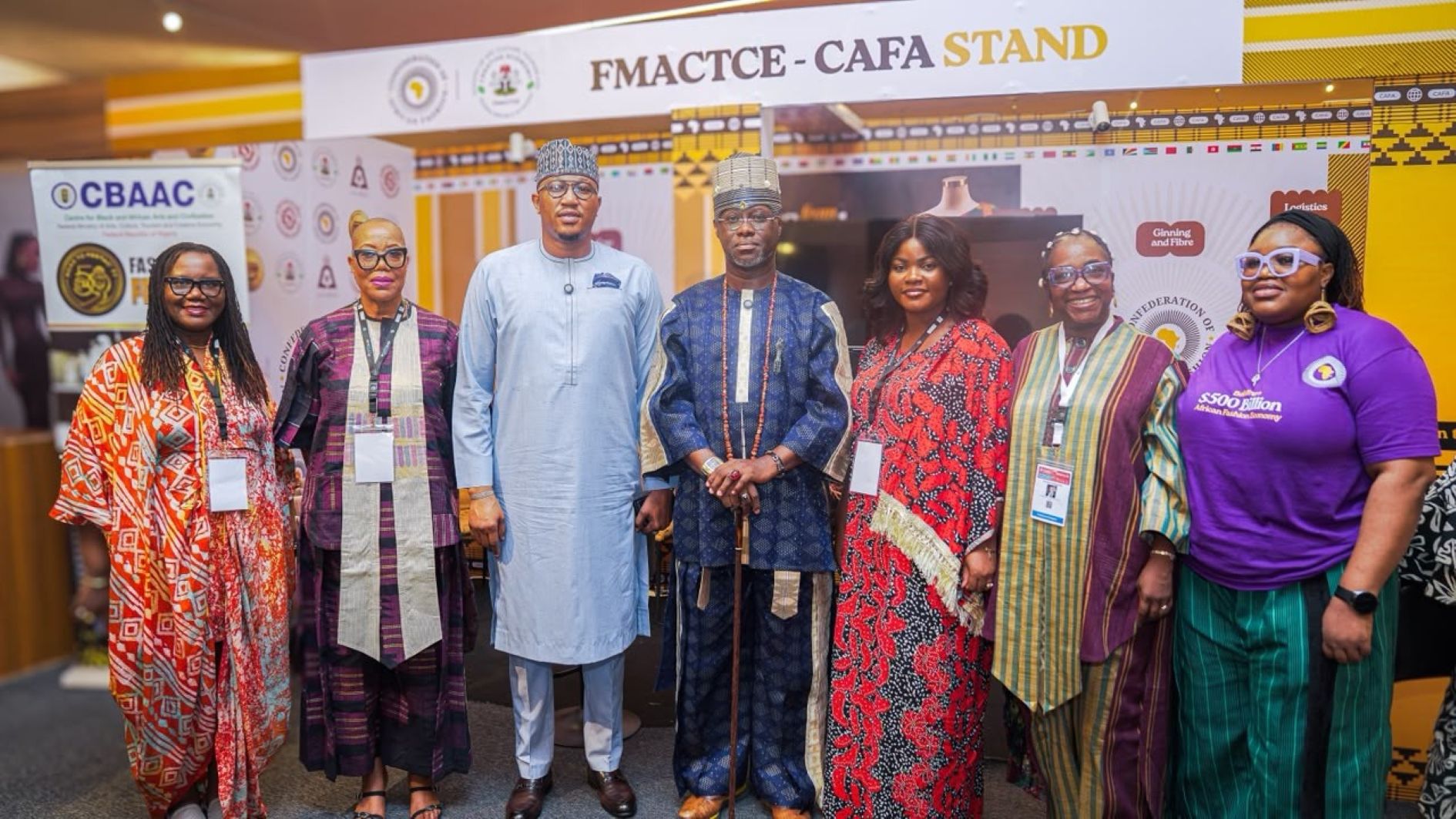

The Confederation of African Fashion (CAFA) wants to grow Africa’s fashion economy to $500 billion by 2036, but conflicting estimates of the industry’s current value raise questions about the scale of growth required to achieve the ambition.
The organisation is calling on African governments to harmonise fashion policies, strengthen intellectual property protection and invest in local manufacturing to retain more economic value within the continent.
CAFA President, Prof. Lai Labode, made the call during the organisation’s activities at the Creative Africa Nexus (CANEX) WKND 2026 in Lagos, according to Vanguard on November 7, 2026.
However, estimates of Africa’s current fashion economy vary significantly, with reports citing figures of both $30 billion and $60 billion.
Voice of Nigeria reported on November 2 that CAFA’s roadmap was designed to expand the industry from an estimated $30 billion to $500 billion. THISDAY also used the $30 billion baseline in its November 3 report.
However, The Guardian reported on November 7 that Labode put the current value of Africa’s fashion economy at approximately $60 billion.
The difference significantly changes the growth required to meet the 2036 target.
Using the $60 billion estimate, the industry would need to expand more than eightfold, requiring compound annual growth of approximately 23.6% over ten years.
Starting from $30 billion, however, the target would require growth of more than 16 times, equivalent to approximately 32.5% annually over the same period.
Neither estimate comes with a clearly published valuation methodology in the reports reviewed, leaving questions about which activities, businesses and markets are included in the industry’s estimated size.
CAFA is pursuing the African Fashion Industry Growth Charter as its framework for addressing structural weaknesses in the sector.
Nigeria became the first country to sign the charter on November 5, 2025, through the Federal Ministry of Art, Culture, Tourism and the Creative Economy.
The organisation is now seeking wider continental adoption, working with Nigeria’s Ministry of Foreign Affairs to engage the African Union, according to THISDAY on November 3.
The Guardian reported on November 7 that CAFA was also discussing participation with Rwanda, Liberia and Ghana, with Rwanda progressing towards becoming the second country to formalise its participation.
The manufacturing gap provides an indication of the economic opportunity behind the initiative.
A 2023 report by UNESCO, titled The Fashion Sector in Africa: Trends, Challenges and Opportunities for Growth, estimated annual African exports of textiles, clothing and footwear at $15.5 billion, compared with imports of $23.1 billion.
This represents an annual trade deficit of approximately $7.6 billion.
The report also identified limited industrial capacity, inadequate investment and weak intellectual property protection among the challenges facing the industry. It noted that 37 of Africa’s 54 countries produce cotton, highlighting the continent’s raw material resources.
CAFA wants to move the industry beyond exporting raw materials towards local processing, garment production and stronger regional and international market access.
The organisation’s website identifies policy coordination, capacity-building, investment connections and market access among its priorities.
However, the $500 billion ambition remains a stated target rather than a publicly demonstrated economic forecast. The reports reviewed do not provide a detailed financing plan, annual production milestones or a consistent baseline for measuring the industry’s current value.
The initiative’s progress will therefore depend on whether governments adopt the charter, investors commit capital and local manufacturers expand production capacity.
Without a credible industry-wide valuation and measurable investment and production targets, it will remain difficult to determine how much progress Africa is making towards the $500 billion ambition.