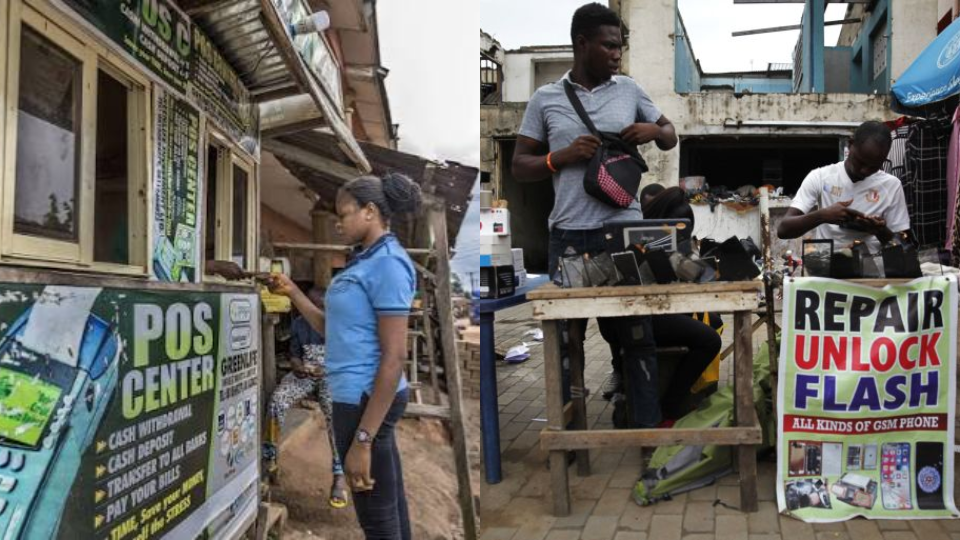

Nigeria’s digital economy is often measured through fintech valuations, mobile subscriptions, electronic payments and broadband investment. But beneath those headline numbers is a less glamorous network of small businesses helping millions of Nigerians access and participate in the formal economy.
Two of the most visible are Point-of-Sale (POS) agents and mobile-phone repairers.
For Nigerians in communities where bank branches and ATMs are limited, POS agents have become an important physical access point to financial services. Customers use the terminals to withdraw cash, transfer money, pay bills and conduct other transactions without travelling long distances or waiting in bank queues.
The scale of activity is substantial. Data from the Nigeria Inter-Bank Settlement System (NIBSS) showed that the value of transactions processed through POS terminals rose 79.03% year on year to ₦18.78 trillion in the first quarter of 2026, from ₦10.49 trillion a year earlier.
The figure represents the value of transactions processed through POS terminals, rather than revenue earned by agents. But it illustrates the growing role of agent-led channels in Nigeria’s payments ecosystem.
The expansion has also brought regulatory and operational challenges. POS agents handle cash, electronic devices and customer transactions, leaving them exposed to risks ranging from fraud and network disruptions to liquidity constraints and equipment costs.
The Central Bank of Nigeria has responded with tighter rules for the sector. In October 2025, the CBN issued its Guidelines for the Operations of Agent Banking in Nigeria, introducing stricter requirements for agents and their principals. The guidelines took effect from their release, while provisions covering agent location and exclusivity became effective on April 1, 2026.
Under the new framework, agents are required to operate exclusively for one principal, while super agents can maintain relationships with multiple principals. The rules are designed to strengthen oversight, improve accountability and reduce risks within the agent-banking system.
Mobile-phone repairers perform a less visible but equally important function.
As smartphones become essential tools for banking, commerce, education, communication and work, keeping existing devices operational can be an important part of maintaining access to the digital economy. A technician repairing a damaged screen, charging port or battery can help a customer remain connected without immediately having to purchase a replacement device.
The size of Nigeria’s connected population underscores the importance of that role.
Nigerian Communications Commission data showed about 157.4 million internet subscriptions in May 2026, while broadband subscriptions reached roughly 122 million. Active mobile subscriptions stood at 189.68 million during the month.
Those figures do not mean 189.68 million individual Nigerians each own a separate mobile phone, since subscriber figures can include multiple connections held by the same person. But they demonstrate the scale of the communications infrastructure supporting digital activity across the country.
For small businesses, that connectivity increasingly translates into economic opportunity.
A working smartphone allows customers to access mobile banking, digital payments, online marketplaces and communication platforms. A POS agent provides a physical bridge between those digital services and customers who still need cash or face barriers to accessing conventional banking infrastructure. The phone repairer helps keep the devices that make many of those services possible in circulation.
The relationship is increasingly circular. A customer may use a repaired smartphone to transfer money to a POS agent, withdraw cash from that agent and later use the same device to pay a supplier or conduct business online.
The significance of these businesses goes beyond the individual transactions they process.
They form part of what could be described as the street-level infrastructure of Nigeria’s digital economy: small enterprises operating at the point where technology meets everyday economic activity.
That makes their operating environment important to the wider digital economy.
Reliable telecommunications networks can reduce failed transactions and downtime for agents. Access to affordable working capital can help businesses maintain liquidity and replace damaged equipment. Technical training can improve the quality and reliability of phone repairs, while stronger security practices can reduce exposure to fraud.
For telecom operators, banks, fintech companies and policymakers, supporting these businesses therefore has implications beyond small-business development. Their performance can influence how easily consumers interact with digital financial and communications services.
Nigeria’s digital transformation is being driven by sophisticated payment platforms, telecom networks and financial-technology companies. But the transformation does not happen only inside data centres, banking applications or corporate headquarters.
It also happens in the small POS kiosk processing a customer’s transfer, and in the repair shop keeping a damaged smartphone alive.
The digital economy may be built on advanced technology, but much of its daily operation still depends on people working at street level. Recognising and strengthening that layer could be an important part of making Nigeria’s digital transformation broader, more resilient and more inclusive.