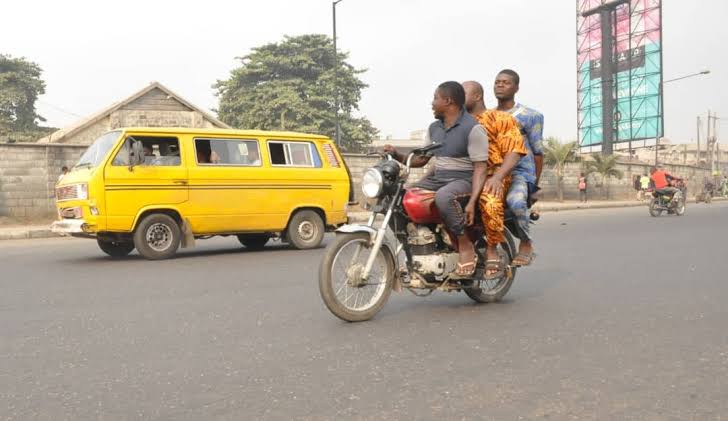

The Federal Government’s decision to restrict commercial motorcycles and tricycles on the Lagos-Calabar Coastal Highway has exposed a familiar tension in Nigeria’s transport policy: protecting public infrastructure and improving road safety can come with immediate economic costs for workers and commuters who depend on informal transport.
The Federal Ministry of Works announced the restriction in June, saying it was necessary to protect newly constructed sections of the coastal highway from misuse and deterioration. The directive also covers bridges across Lagos State, while authorities have separately warned against indiscriminate parking of trucks and articulated vehicles and the dumping of refuse along highway corridors.
The ministry has installed warning signs and said enforcement teams would be deployed at strategic locations. The restriction is specifically directed at commercial motorcycles and tricycles; privately owned motorcycles and delivery bikes were reported as unaffected.
For the government, the logic is straightforward. The Lagos-Calabar Coastal Highway is a major long-term infrastructure investment designed to improve connectivity and economic activity along Nigeria’s southern corridor. Protecting newly built road sections from activities authorities consider incompatible with their intended use is therefore part of preserving the value of the investment.
For transport operators, however, restrictions create a different economic calculation.
Commercial motorcycles and tricycles have expanded partly because they can provide relatively flexible point-to-point and last-mile transport, particularly where conventional bus services do not reach efficiently. Removing them from a major corridor can shift passengers towards fewer permitted transport options, potentially increasing journey times or forcing additional connections.
Lagos has confronted the wider issue before. In 2020, the state imposed restrictions on commercial motorcycles and tricycles across several local government and council development areas, citing safety and traffic concerns. The government has since continued to promote mass-transit alternatives as part of a broader shift away from dependence on informal transport.
The safety argument remains significant. During the 2020 debate, Lagos authorities cited more than 10,000 motorcycle and tricycle-related accidents and over 600 deaths recorded at government hospitals over a three-year period. Those figures were government-reported statistics and should not be treated as a nationwide measure of motorcycle-related casualties.
The deeper policy challenge is what happens after enforcement.
A successful transport transition requires more than banning a mode of travel. It requires sufficient alternatives for passengers and realistic economic pathways for operators whose access to particular routes has been removed.
That makes the coastal highway restriction more than a road-management decision. It is also a test of whether Nigeria can modernise urban transport without transferring the full cost of reform to informal workers and low-income commuters.