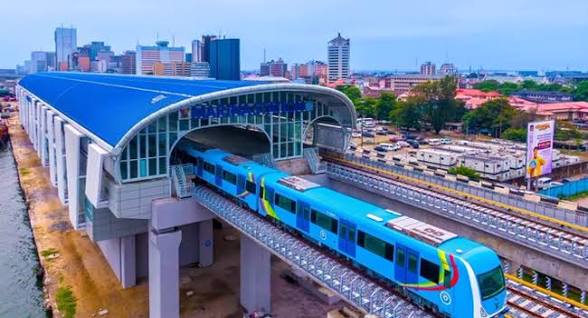

The Lagos Rail Mass Transit (LRMT) Blue Line has transported more than eight million passengers since commercial operations began in September 2023, underscoring the growing role of rail transport in easing congestion across Nigeria’s commercial capital.
The milestone, announced on Thursday, July 16, 2026, by China Civil Engineering Construction Corporation (CCECC) Nigeria, comes just over 1,000 days after the state’s first electric intracity rail service commenced operations. According to the company, the Blue Line has maintained a strong safety record while steadily expanding its commuter base.
“The Lagos Rail Mass Transit-Blue Line, built and operated by CCECC Nigeria, has safely served over 8 million passengers in more than 1,000 days of operation,” the company said in a statement shared via its official X account.
The achievement highlights increasing public adoption of rail transport in Lagos, where chronic road congestion has long imposed significant economic costs through lost productivity, higher logistics expenses and extended commuting times.
The 13-kilometre Phase I corridor, linking Marina to Mile 2, has become one of the city’s busiest public transport routes. Ridership has continued to accelerate, reflecting growing demand for reliable alternatives to road transport.
The announcement coincided with another key development for the project, as CCECC confirmed the successful installation of the first precast T-beam for Phase II of the Blue Line.
A precast T-beam is a reinforced concrete structural component manufactured off-site before being lifted into place to support elevated railway bridges. Its installation signals that construction has progressed beyond piling, foundation and pier works into the superstructure stage, one of the most critical phases of rail infrastructure development.
The 14-kilometre Phase II extension will connect Mile 2 to Okokomaiko along the Lagos-Badagry corridor. The expansion will add six stations—Festac, Alakija, Trade Fair, Volkswagen, LASU and Okokomaiko—while a 400,000-square-metre depot at Okokomaiko will serve as the network’s maintenance and operations hub.
As part of the expansion, the existing Mazamaza Bridge will be replaced after structural assessments found it unsuitable for rail operations. Additional bridges will also be constructed at Satellite and LASU to accommodate the new line.
The Lagos State Government expects construction to be completed by the end of 2026, with passenger services scheduled to begin in the first quarter of 2027.
The Blue Line forms part of the 27-kilometre standard-gauge electric railway being developed by the Lagos State Government through the Lagos Metropolitan Area Transport Authority (LAMATA) under the state’s Strategic Transport Master Plan. The blueprint has since expanded from six proposed rail lines to 11 rail lines and one monorail, reflecting Lagos’ long-term ambition to build an integrated urban mass transit network.
In a further push to strengthen the sector, LAMATA and CCECC recently signed an agreement to establish a Railway Training Centre to develop local expertise in railway operations, maintenance and management.
With daily train services recently increased from 90 to 94 trips and operating hours extended to begin at 6:00 a.m., the Blue Line continues to scale capacity to meet rising commuter demand. Surpassing eight million passenger journeys reinforces the railway’s growing contribution to urban mobility and highlights sustained investment in modern transport infrastructure as Lagos seeks to support its expanding population and economy.