
Electricity in Lagos has long remained a defining factor in the daily realities of residents and business owners. It influences productivity, shapes income levels, and determines the ease with which households and enterprises function. Against this backdrop, the Lagos State Government has introduced a decentralised power initiative through new Power Purchase Agreements (PPA) aimed at improving electricity delivery across the state. The initiative is designed to strengthen local generation, reduce dependence on the national grid, and ensure more reliable power supply to critical sectors.
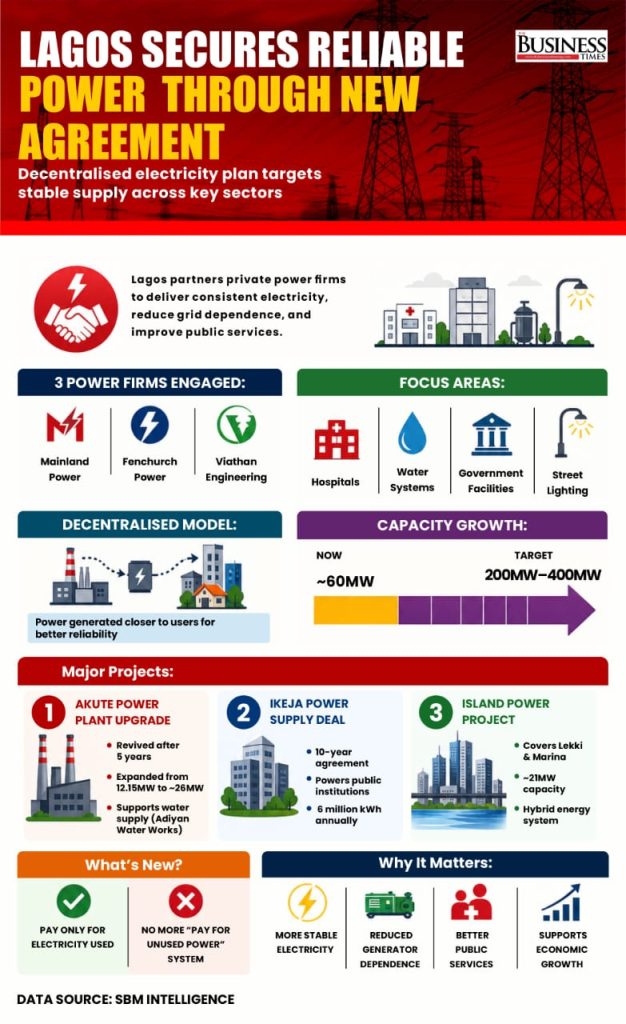
The agreements involve three Independent Power Producers: Mainland Power Limited, Fenchurch Power Limited, and Viathan Engineering Limited. Together, they are expected to deliver decentralised electricity solutions to key public infrastructure, including hospitals, water treatment facilities, and government establishments. The state government has also emphasized a shift in payment structure, ensuring that electricity charges are based strictly on actual power supplied, rather than estimated or unused capacity. This approach is intended to improve accountability and efficiency in the system.
While the policy direction reflects a major structural reform, the real test lies in how it affects everyday people. For many Lagos residents and business owners, electricity is not a policy discussion, but a daily struggle that directly affects survival and stability.
For Omolade Patience, a frozen food business owner, the impact of unstable electricity is deeply personal and financially draining. She explains that lack of electricity has consistently reduced her sales, forcing her to rely heavily on generators. According to her, “Lack of electricity reduces sales for me most times. As someone who sells frozen foods, I have to depend on the use of a generator sometimes which is also expensive at the moment. So, both my profit and capital are being used to sort out power issues so that my goods won’t get spoiled. And it’s eating my business up.”
Her concern goes beyond inconvenience. The rising cost of fuel has added another layer of pressure to her business operations. She notes that the financial strain is becoming increasingly difficult to manage, especially with the continuous increase in petrol prices. “The financial strain is weighing on my business, I won’t lie. And to make things worse, the cost of petrol is really alarming,” she adds.
Despite these challenges, she expresses cautious optimism about the Lagos initiative. She believes that a stable electricity supply would significantly improve her business performance by reducing reliance on generators and preventing the spoilage of goods. In her words, “If Lagos’ new initiative works out and there is a stable power supply, then my goods won’t get spoiled. I won’t have to buy fuel constantly. And I’ll make more sales and have more profit. Improvement in power supply is an improvement in sales for me.”
From a community perspective, residents also share similar hopes. Stephen, a Lagos resident, describes electricity supply as inconsistent and unpredictable. He explains that while there are occasional moments of improved supply, stability remains a major challenge. “So, it’s not stable. There are times when the power supply will be really available, and there are times we will barely have light. So I cannot say it is really stable,” he says.
However, he acknowledges the potential benefits of improved electricity supply if the Lagos initiative succeeds. According to him, stable power would have a positive ripple effect on community development and quality of life. “A stable power supply will put the community on the good side. Having regular light will help improve the livelihood of community members in various ways,” he states.
The Lagos State Government’s decentralised power model is expected to address some of these concerns by generating electricity closer to consumption points. This includes major projects such as the rehabilitation of the Akute Independent Power Plant, which will increase capacity from 12.15 megawatts to about 26 megawatts. The upgraded facility is expected to support water supply systems and surrounding communities.
In addition, the Ikeja corridor will continue to benefit from a long term supply agreement with Mainland Power Limited, ensuring electricity for hospitals, public institutions, and essential services. On Lagos Island, Viathan Engineering Limited will manage and expand the Island Power Project, which serves key commercial and residential areas such as Lekki and Marina.
While these developments signal strong policy intent, their success will ultimately depend on consistent implementation and tangible results for end users. For now, residents and business owners remain cautiously hopeful that the decentralised model will translate into real improvement in their daily lives.In many ways, the Lagos power initiative represents more than infrastructure reform. It is a test of how policy decisions intersect with lived experiences. For people like Omolade and Stephen, the expectation is simple and direct, reliable electricity that supports work, reduces costs, and restores stability to everyday life.