
Nigeria’s inflationary trend recorded a slight upward movement in March 2026, reflecting continued pressure on household budgets despite earlier signs of moderation in price growth. While the broader inflation outlook shows improvement compared to last year, recent data suggests that cost pressures remain firmly embedded in the economy.
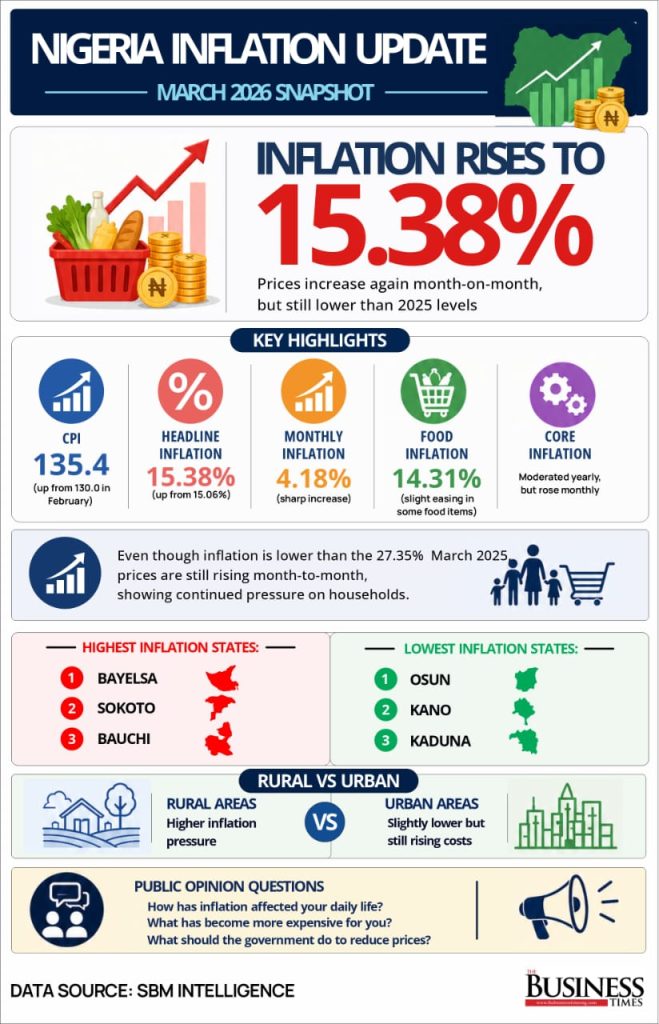
According to figures released by the National Bureau of Statistics (NBS), the Consumer Price Index (CPI), which tracks changes in the average prices of goods and services, rose to 135.4 points in March 2026, up from 130.0 in February. This increase signals a continued rise in the general price level across the country.
On a year-on-year basis, headline inflation stood at 15.38%, slightly higher than the 15.06% recorded in February. Although the increase appears marginal, it marks a reversal after several months of gradual easing. Notably, inflation remains significantly lower than the 27.35% recorded in March 2025, indicating that earlier policy interventions and macroeconomic adjustments have contributed to some stabilization. However, monthly inflation data presents a more pressing picture. Prices rose by 4.18% in March alone, more than double the rate recorded in the previous month. This suggests that consumers are still experiencing noticeable increases in the cost of goods and services within short time intervals, particularly in essential categories such as food and transportation.
Separately, the SBM Jollof Index, a widely followed measure of household food affordability, is due for publication on Thursday. The index tracks the cost of preparing a pot of jollof rice for a family of five across major markets in Nigeria, providing a grassroots perspective on how inflation translates into everyday cooking expenses. The forthcoming report is expected to show that the national average cost of jollof rice has continued to rise in the first quarter of 2026, driven by higher transport costs and energy prices, reinforcing the official inflation data’s signal that price stability remains elusive for many families.
Food inflation, which remains a key driver of overall price levels in Nigeria, stood at 14.31% year-on-year. While this reflects a decline compared to previous highs, food prices continue to place significant strain on households, given the proportion of income typically spent on basic consumption needs. Some relief was observed in the slower price increases of staples such as yam, cassava, and tomatoes, suggesting mild seasonal or supply-side improvements.
Core inflation, which excludes volatile items like food and energy, also showed mixed movement. It moderated on a yearly basis but increased month-on-month, indicating persistent underlying cost pressures in sectors such as housing, transport, and services. A major factor influencing recent inflationary trends is the continued rise in fuel and transportation costs. Global energy market conditions, alongside domestic adjustments in the downstream petroleum sector, have contributed to higher logistics costs. Given Nigeria’s heavy dependence on road transport for goods distribution, these increases quickly feed into broader price levels, especially food.
An economist commenting on the trend noted that transport costs remain a central inflation driver in the country, as increases in fuel prices inevitably cascade into higher production and distribution expenses. Preliminary findings from the SBM Jollof Index, due this Thursday, are expected to align with this view, showing that the cost of moving goods from farms and ports to markets has been a primary contributor to the rising price of the meal. The index’s detailed market-level data may offer a more granular picture of how fuel and transport shocks are transmitted to the average Nigerian’s pot.
Inflation patterns across the country also reveal regional disparities. Rural areas continue to experience higher inflation compared to urban centres, largely due to weaker infrastructure, limited market access, and higher transportation costs. At the state level, Bayelsa, Sokoto, and Bauchi recorded the highest inflation rates, while Osun, Kano, and Kaduna experienced relatively slower increases.
Monetary policy measures by the Central Bank of Nigeria have contributed to reducing inflation from previous peaks of around 30% to current levels. However, experts note that monetary tightening alone is insufficient, as structural challenges, particularly in agriculture, logistics, and energy supply, continue to exert upward pressure on prices.Looking ahead, inflation is projected to remain in the 15–16% range in the short term. While this suggests relative stability compared to previous years, it also indicates that price levels are unlikely to decline significantly in the near future without deeper structural reforms.
Household Perspectives: How Nigerians Are Coping
Beyond the statistical figures, the impact of inflation is strongly felt in everyday life, as reflected in responses from ordinary Nigerians.
Theophilus Babatunde, a Lagos-based respondent, explained that rising prices have significantly altered his spending pattern. According to him, daily expenses on food and transportation have nearly doubled, forcing him to rely more on local markets and home-cooked meals to manage costs.
Similarly, Roheem Hassan described inflation as increasingly difficult to manage, noting that he now reduces discretionary spending and adopts cost-saving habits such as trekking short distances and limiting consumption of non-essential items. He observed that while official figures may suggest slowing inflation, real-life experiences indicate otherwise.
Another respondent, Blessing Obiajulu Etoroma, highlighted the impact on household consumption, particularly food-related expenses. She explained that rising prices have forced her to reduce purchase quantities, switch to cheaper alternatives, and eliminate certain meals from her household budget. She also noted the importance of visiting nearby markets to reduce transport-related costs.
Across these responses, a consistent theme emerges: Nigerians are adapting their lifestyles to cope with sustained price increases. Common coping strategies include bulk purchasing, reduced consumption of non-essential goods, increased home cooking, and greater price sensitivity when making purchasing decisions.ConclusionNigeria’s March 2026 inflation data presents a mixed economic picture. While the overall annual inflation rate remains significantly lower than levels recorded in 2025, recent monthly increases highlight persistent vulnerabilities in the cost structure of the economy.
For policymakers, the challenge lies in sustaining macroeconomic stability while addressing structural bottlenecks that continue to drive prices upward. For households, however, the focus remains immediate, adjusting daily spending to match rising costs. Ultimately, while inflation may be moderating on paper, its real impact continues to shape consumption patterns, household welfare, and economic behaviour across the country.