
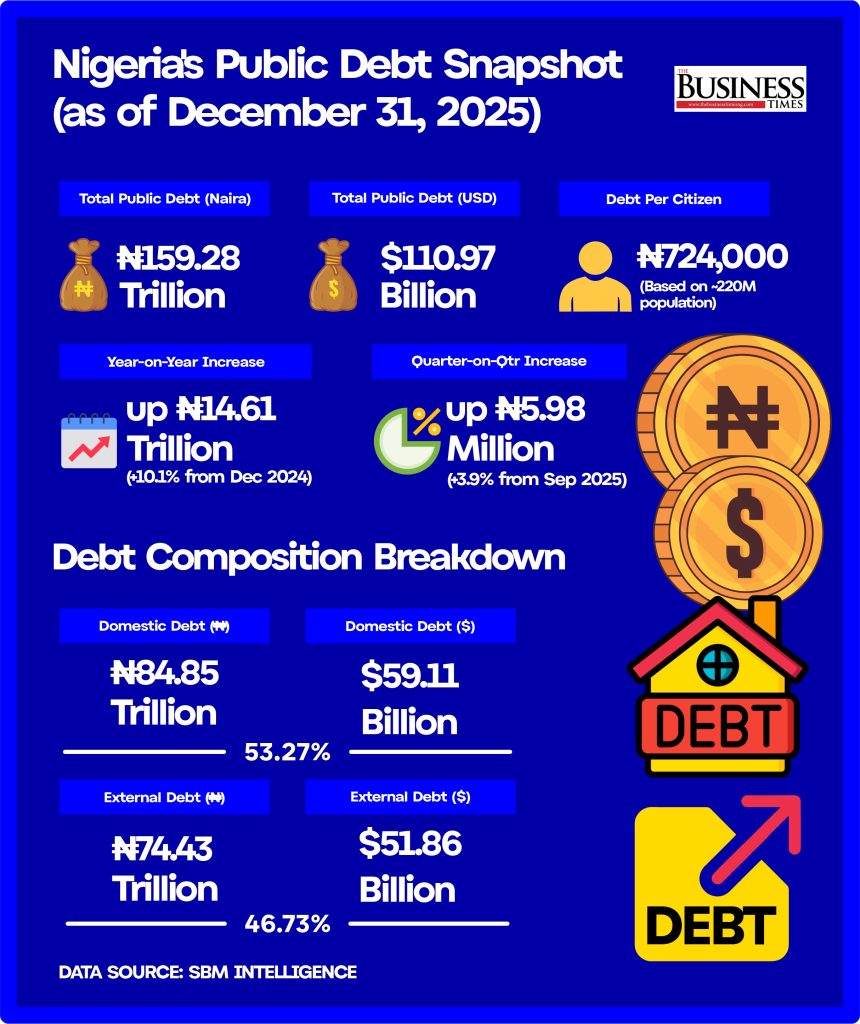
Nigeria’s total public debt climbed to N159.28 trillion as of December 31, 2025, a figure that translates into an average burden of approximately N724,000 for every citizen, based on a population estimate of 220 million. The latest data from the Debt Management Office, released in mid-April 2026, has shifted the national conversation from abstract trillions to a deeply personal question: what does each Nigerian owe, and what have they received in return? With the debt stock rising by N5.98 trillion in the final quarter of 2025 alone and the government seeking an additional $6 billion external loan for port rehabilitation, the debate over fiscal sustainability has intensified across policy circles, financial markets, and household dining tables.
The Numbers and Official Transparency
The DMO’s breakdown shows that domestic debt remains the largest component at N84.85 trillion, or 53.27 per cent of the total, with the Federal Government holding N80.49 trillion and states and the FCT accounting for N4.36 trillion. External debt stood at N74.43 trillion ($51.86 billion), representing 46.73 per cent. The debt stock rose from N153.29 trillion in September 2025 to N159.28 trillion in December 2025, a quarterly increase of 3.9 per cent, and is expected to climb further after factoring in the recently approved N8.3 trillion borrowing from the UAE and UK Export Finance.
Patience Oniha, Director-General of the DMO, defended the agency’s approach in an official press statement on April 15, 2026, saying, “The N159trn figure is a comprehensive view of our national obligations; we remain committed to transparency and strategic management of these liabilities.” A DMO representative further explained to The Cable that Nigeria’s debt-to-GDP ratio remains moderate, adding that the country is “leveraging capital to fund structural adjustments that will stabilize the economy.” The DMO also noted that the provisional figure includes the domestic and external debts of all 36 states and the FCT, ensuring a comprehensive national view.
Government’s Case
The Presidency has framed the rising debt as a necessary tool for infrastructure-led growth. Bayo Onanuga, Special Adviser to the President, defended the new $6 billion external loan request in a policy brief released this week, stating, “Borrowing to rehabilitate the Tin Can and Lagos ports is a strategic investment that will unlock billions in maritime revenue to repay the loans.” A separate presidential briefing reiterated that “borrowing is a structural part of our budget; the $6bn loan for Lagos and Tin Can ports will unlock billions in maritime revenue.”
Olusegun Dada, Special Assistant to the President, took to X on April 15 to explain the government’s shift toward external financing: “Concessional loans from the World Bank are the cheapest way to fund our structural reforms; it is better than domestic borrowing at high interest rates.” This argument received an unexpected endorsement from the Global Banking & Markets Africa Awards, which presented the DMO with two prestigious awards in early April 2026. The official citation read: “This award recognizes Nigeria’s strategic and transparent approach to debt management in a volatile global market.” The organisers praised the DMO’s “excellence in managing a complex debt portfolio” and Nigeria’s “resilience despite global volatility.”
Where Did This Money Go?
For millions of Nigerians, the per‑capita debt figure of N724,000 has become a lightning rod for anger and disbelief. Emeka Nwosu, a small business owner interviewed by Daily Trust following the debt report, said: “I have never even seen N724,000 in my savings account, yet the government says I am already owing that amount. This is a generational curse.” An anonymous Nigerian citizen’s sentiment, which went viral on X, captured the same frustration: “I am yet to even earn N724,000 in my life, yet the government says I already owe it. Where did this money go? We don’t see the projects.”
Mrs Zainab Abdullahi, a teacher and mother in Kaduna, commenting on a viral WhatsApp thread, added a tangible dimension to the visibility gap: “My children are in public school and the roof is leaking. If we owe N159 trillion, where are the projects? We only see the debt, not the development.” Her words reflect a broader disconnect between the government’s narrative of borrowed funds financing infrastructure and the deteriorating state of schools, hospitals, and roads across the country.
Opposition and Analyst Warnings
Opposition figures and financial experts have been scathing. Peter Obi, leader of the Labour Party, posted on his verified social media accounts on April 15: “We are borrowing N17.9 trillion this year while debt servicing alone gulps N15.5 trillion. We are essentially borrowing to pay interest, not to build.” In a separate post reacting to the DMO’s first‑quarter report, he called the fiscal trajectory “fiscally reckless,” noting that debt servicing consumes nearly half of projected revenue. The African Democratic Congress issued an official party statement on April 14, describing the 2026 budget as “a debt trap” that will “mortgage the country’s future and burden the next generation.”
The media has also weighed in. A News Central TV editorial from the “Which Way Nigeria” segment aired on April 13 argued that “under this administration, creditors are paid before classrooms are fixed or hospitals are funded. We are borrowing to survive, not to build.” Tilewa Adebajo, CEO of CFG Advisory, told CNBC Africa on April 12 that “the 2026 budget is untenable. Nigeria’s current debt profile at over $110 billion with current service levels is a financial quagmire,” calling for an urgent budget review.
The Test of Conversion
Amid the polarised debate, some analysts have urged a more measured assessment. The BusinessDay Editorial Board, in an analysis titled “The Burden of Proof” published on April 15, wrote: “Whether the government can convert these borrowed resources into durable economic capacity is the narrow test they must pass to justify the burden.” Another BusinessDay editorial on borrowing priorities asked, “Who decides Nigeria’s borrowing priorities?” – a question that underscores the need for clearer criteria and public accountability.
Dr Aliyu Ilias, a development expert speaking on a Channels TV news panel about the trade‑offs of the $6 billion loan request, offered a pragmatic neutral perspective: “The numbers are alarming, but we must ask: what is the alternative? If we don’t borrow for the ports and power, the economy will stagnate further.” Johnson Chukwu, CEO of Cowry Asset, provided analysis to CNBC Africa regarding the planned sale of state assets to offset the N159 trillion debt, noting: “Macro indicators show some promise, but the challenge is the disconnect: revenue assets are open for sale while debt continues to edge higher.”
Intergenerational Burden and Revenue Gaps
Financial expert Dr Paul Alaje, speaking to Daily Trust, deepened the analysis by focusing on who ultimately pays. He stated that the current debt stock is directly owed by Nigerians and will be paid by even citizens not yet born. “The question is who will pay this debt? Will the government pay? Will the people pay? Once you are part of the citizens, government can decide to raise taxes and everybody will pay. So it is everybody that pays.” He warned that if the debt extends two decades or more, unborn generations will also be burdened.
On why the government continues to borrow despite announcing record revenue collections, Alaje explained that revenue generation takes time while salaries must be paid immediately. “Our need and what we are generating are two different conversations. Our need may expand, which is totally out of our control. When what we are generating in revenue is not enough, and we need to spend, we have to borrow.” This structural mismatch between revenue timing and expenditure obligations, rather than outright fiscal profligacy, lies at the heart of Nigeria’s persistent borrowing cycle.
The Narrow Path Ahead
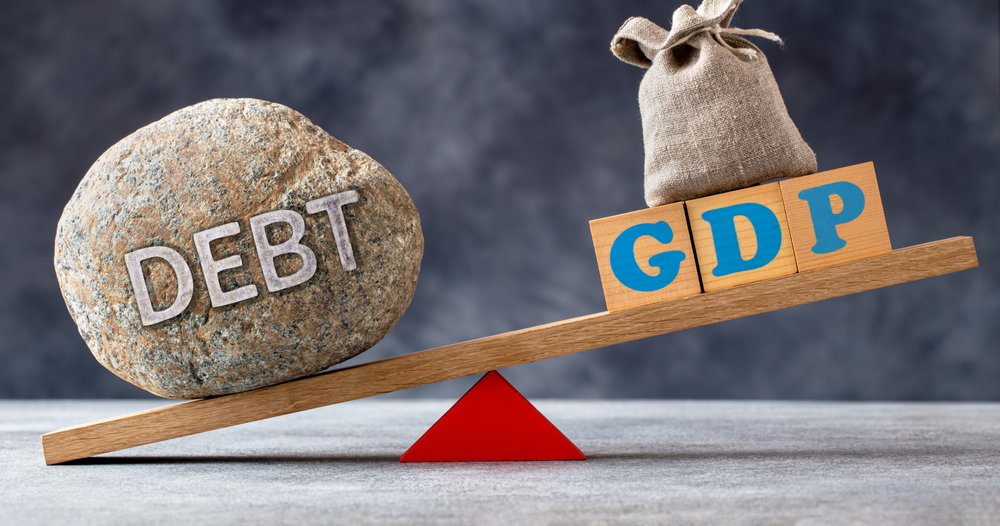
The Central Bank of Nigeria’s 2026 macroeconomic outlook projects a debt‑to‑GDP ratio of 34.68 per cent by year‑end, up from 33.98 per cent in June 2025. That metric, while moderate by international standards, masks the more critical challenge: debt service consumes a substantial portion of government revenue, leaving limited fiscal space for capital expenditure and social services. The per‑capita figure of N724,000 may be a statistical artefact, but it has successfully personalised a national crisis. Whether the current borrowing translates into ports that actually increase trade, power that reliably reaches factories, and schools that do not leak will determine if future generations inherit a productive economy or merely a larger bill.