The fundamental challenge facing the Nigeria Premier Football League (NPFL) has long been its difficulty in transitioning from a state-subsidized entity to a commercially viable sporting product. That challenge was starkly illuminated recently following the violent pitch invasion during the Match Day 8 fixture between Kano Pillars FC and Shooting Stars Sports Club (3SC) at the Sani Abacha Stadium. The subsequent comprehensive sanctions imposed by the league office, a deduction of three points and three goals, a total fine of ₦9.5 million, and the banishment of home matches to Katsina, represent more than mere disciplinary action; they signal an urgent, costly investment in the league’s integrity.
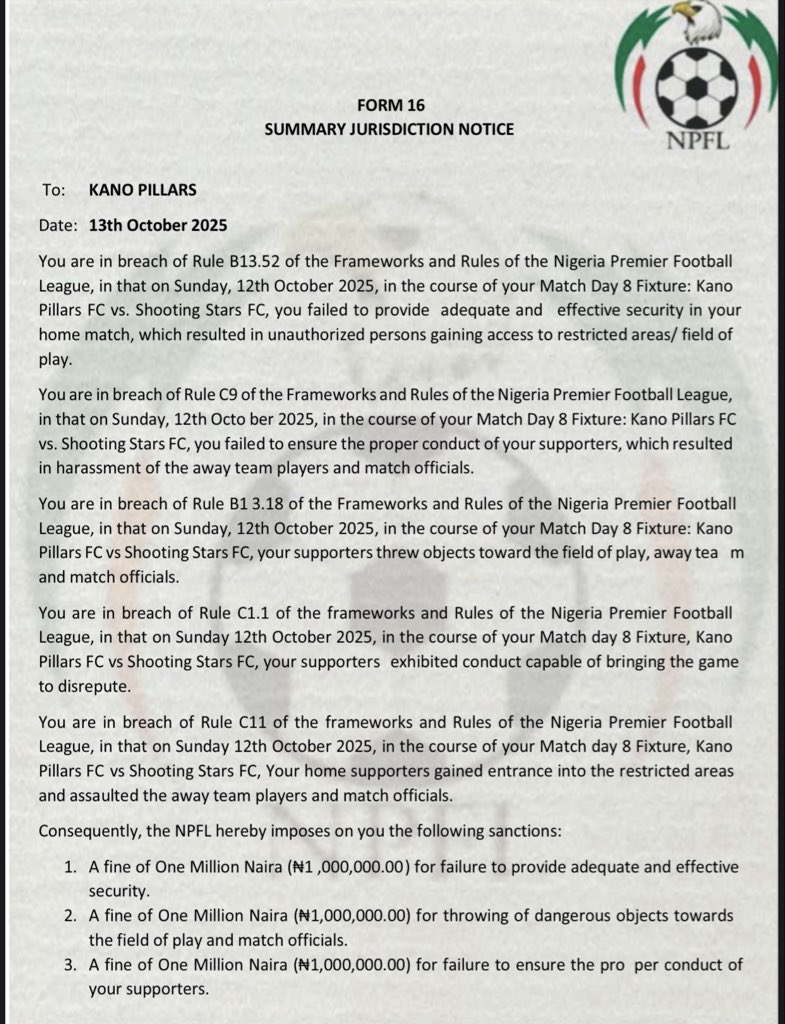

For a club like Kano Pillars, the economic consequences of this penalty are immediate and severe. The substantial fine, levied across multiple infractions including inadequate security and assault on match officials, creates a significant strain on a budget often reliant on government appropriations. Compounding this fiscal blow is the banishment of the team’s remaining home fixtures. As one of the best-supported clubs in the NPFL, Pillars generates measurable revenue from large crowds at the Sani Abacha Stadium. By forcing the club to play in Katsina, the league has eliminated this vital source of matchday income while simultaneously increasing the club’s operational expenditure due to mandated long-distance travel, accommodation, and logistics for every ‘home’ fixture. This economic reality demonstrates the direct cost of institutional failure to control supporters.
The NPFL has struggled to attract the substantial commercial sponsorships and consistent broadcast partners that fuel successful global leagues, primarily because of a perceived lack of security and unpredictable match environments. Repeated incidents of violence compromise the league’s ability to guarantee a safe product, which is the baseline requirement for any major corporate investment. The decisive nature of the sanctions, which were issued within 24 hours of the incident, is therefore an attempt to rebuild trust and signal a zero-tolerance policy necessary for commercial stability.
Stakeholder response to the ruling reflects a consensus on the need for decisive action, though opinions vary on its severity. Shooting Stars, the affected away team, immediately stressed the need for accountability and justice, confirming that players and officials, including Ismail Ayodele and Adams Agba’a, had suffered head injuries and that violence was “unacceptable” in the sport. Kano Pillars’ General Manager, Ahmed Musa, acknowledged the gravity of the incident, issuing a public apology to all stakeholders and promising to cooperate with authorities to identify and prosecute the individual perpetrators, calling the incident “shameful and completely unacceptable.”
However, some analysts, such as Fisayo Dairo, questioned the geographical choice of the banishment venue. Dairo argued that relocating the club’s home games to Katsina, which is geographically close to Kano, might not be an adequate deterrent, stating that the punishment would have been more effective had the club been moved to a location farther away to introduce genuine logistical inconvenience. Conversely, NPFL Chief Operating Officer Davidson Owumi defended the decision, emphasizing the severity of the financial component and the historical context. Owumi noted that the fines were unprecedented in magnitude, a step taken to ensure the penalty matched the severity of the breach, adding that a point deduction alone is often enough to send a club into relegation battles.
In conclusion, the disciplinary action taken against Kano Pillars carries a clear short-term economic price for the club, effectively neutralizing their home advantage and increasing their budget deficits. Yet, this painful step is positioned by the league as a mandatory investment in the NPFL’s long-term commercial credibility. By prioritizing the safety of participants and the integrity of the competition above the popularity of a major club, the league seeks to establish the secure environment required to attract the private capital and media partnerships essential for the NPFL’s sustainable economic growth.