
A new report by SBM Intelligence will document how land disputes across Nigeria have evolved from isolated communal conflicts into a national economic crisis with direct, measurable impacts on food supply chains, market stability, and consumer prices. Drawing on a six-year dataset of violent incidents and a survey of 209 traders across nine cities, the report, titled The Price of a Parcel, will show that land conflicts now touch every geopolitical zone and affect the livelihoods of millions far beyond the immediate violence.
The study, which will be published on March 31, tracks 54 violent land-related incidents between October 2019 and January 2026, resulting in at least 112 confirmed fatalities. The data shows a worrying escalation, with 2024 recording the highest annual toll—17 incidents and 39 deaths. While 2025 saw a slight decline in incidents, violence has persisted into 2026, including a deadly clash in Niger State in January that claimed two lives.
Victor Ejechi, head of insights at SBM Intelligence, said the report’s findings challenge the perception that land disputes are merely rural or regional problems. “What we are seeing is a national crisis that transcends regional boundaries. Violence linked to land disputes is not confined to any single zone; it erupts in the South-South delta, the North-Central belt, the South-East, and beyond. The survey data shows that 72.7 per cent of traders nationally have direct experience of the impacts of land conflict, ranging from 54.5 per cent in the North-East to an astonishing 92.3 per cent in the South-West,” he said.
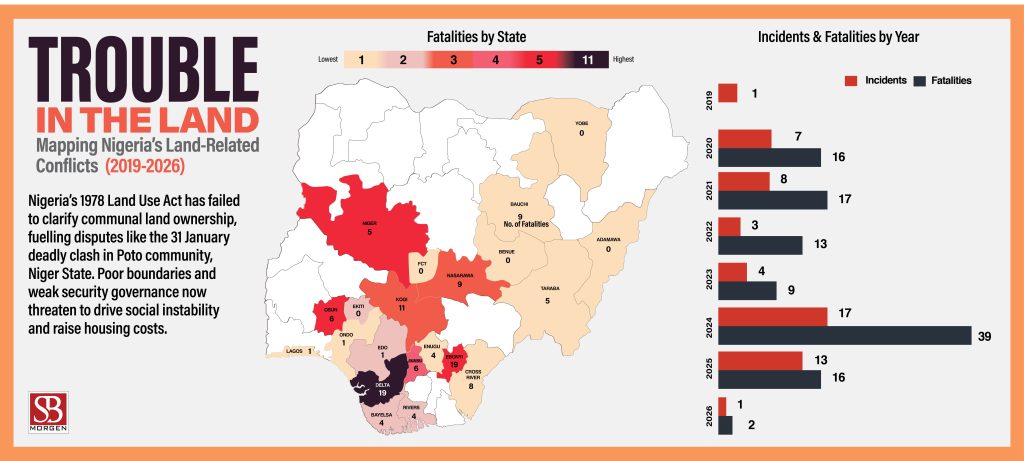
The report combines two primary data sources: SBM’s incident database and a quantitative survey of traders and vendors across Abuja, Awka, Bauchi, Calabar, Ibadan, Kano, Lagos, Onitsha, and Port Harcourt. The survey was designed to capture how land disputes affect supply chains, business operations, and perceptions of governance. “Traders and vendors receive goods from various parts of the country and as a result have a finger on the pulse of conflict whenever there are supply constraints,” the report notes.
The findings reveal stark regional vulnerabilities. Abuja recorded the highest supply chain disruption score nationally, reflecting its role as a convergence point for agricultural products from conflict-affected areas across the Middle Belt. Ibadan presented the most alarming profile, with 100 per cent of traders reporting direct or indirect experience with land conflict. Lagos, meanwhile, faces a distinct urban land crisis, where traders reported the lowest tenure security nationally, with 33 per cent fearing removal from their market spaces at any time.
The report also documents a profound crisis of governance. Perceived authority effectiveness averaged just 2.05 out of 4.0 nationally, with only 3.3 per cent of respondents rating authorities as “very effective” in resolving land disputes before they turn violent. Ejechi noted that this institutional weakness perpetuates cycles of violence. “There is a general lack of confidence in the ability of local governments or traditional rulers to resolve disputes before they turn violent. In Ibadan, 71 per cent describe authorities as ‘not very effective.’ Abuja and Kano also show high levels of dissatisfaction, with 30 per cent of respondents stating authorities are ‘not effective at all.’”
The human toll of land disputes is captured in the voices of those directly affected. In Abuja, Federal Capital Territory Minister Nyesom Wike drew both support and criticism after ordering the demolition of an estate he said was built illegally on land designated for park and recreation. “This place was given for park and recreation, not for the development of an estate. Nobody will allow that… we will do the right thing,” Wike said during an inspection of infrastructure projects.
In Enugu State, community leaders have pushed back against alleged land grabbing. Dr Modester Muoneke, leading a protest in Ishi-Ozalla, declared, “Our grandfather’s land is not your property, hands off now… No consent, no construction.” Meanwhile, property developer Mike Onu offered a contrasting perspective in the same dispute, stating, “I lawfully acquired the land and followed due process in the transaction.”
In Lagos, where urban land pressures are most acute, residents facing displacement have voiced deep frustration. A 75-year-old retiree protesting against the LAMATA rail project demolitions said, “This is my only home. Even if compensation is offered, it must be adequate… taking a loaf of bread and offering a token is unjust.” Engr Iniobong Offiong, coordinator for over 300 homeowners in Ojo, added, “It is a clear disregard for the rule of law. Despite a court order, officials continue to enter the community under armed guard, drilling and collecting data.”
The report also highlights the role of policy framing in addressing farmer-herder conflicts. Ojo Maduekwe, writing for The Gazette, criticised the government’s approach: “By leaning on climate change narratives, the President is choosing to sidestep the truth: persistent violence against farmers is a failure of law enforcement.”
Ejechi said the report’s findings point to a clear set of policy priorities. “Improved security on highways and farming communities is the top priority, selected by 43.5 per cent of respondents nationally. This reflects a widespread consensus that physical protection is the prerequisite for all other interventions,” he said, drawing directly from the report’s conclusion. He added that beyond security, interventions must be tailored to regional realities—faster court resolution in Lagos, boundary demarcation in Kano, and coordinated Middle Belt security efforts to protect supply chains serving Abuja.
The report concludes by calling for comprehensive reform of the Land Use Act of 1978, which it describes as a primary driver of uncertainty and competing claims. “Reforming Nigeria’s Land Use Act is a necessary prerequisite for addressing land conflicts and associated security challenges, as its current centralised structure, a relic of its 1978 military-era origins, has become a primary driver of disputes rather than a solution,” the report states.
As Nigeria prepares for the report’s public release on March 31, Ejechi emphasised the urgency of action. “The alternative is to continue the cycle documented in this report: long-standing disputes escalating into lethal violence, communities trapped in eye-for-an-eye retaliation, supply chains repeatedly severed, markets destabilised, and the nation’s food security held hostage to unresolved arguments over the earth beneath our feet,” he said.