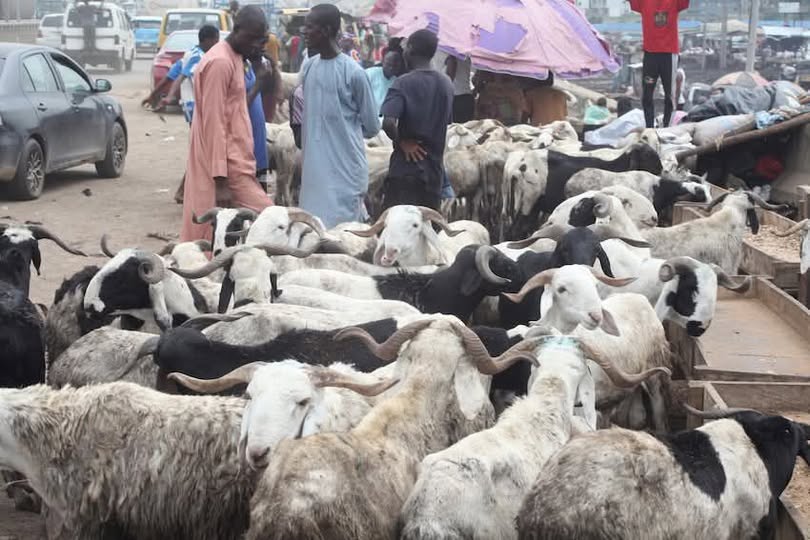

Traders at Oyingbo and Surulere markets are reporting subdued patronage during the Eid al-Fitr season, as fluctuating food prices and rising fuel costs reshape buying patterns across Lagos’s retail landscape. While some commodities have recorded price drops following fresh harvests, others remain persistently high, and the recent increase in fuel prices has further weakened consumers’ purchasing power by driving up transportation and logistics costs that ultimately pass through to retail prices.
At Oyingbo Market, staple food items illustrate the uneven impact of current price dynamics. Mrs Bose Adeyemi, an egusi trader, noted that despite steady supply, the commodity remains relatively expensive. A derica of hand-peeled egusi sells for about N3,000, while the engine-peeled version goes for N1,500. She explained that hand-peeled egusi, prized for its cleaner and whiter appearance, is often preferred by customers who believe it produces better taste when cooked. A paint bucket of egusi, containing about five dericas, sells between N8,500 and N10,000 depending on quality. Fellow trader Mrs Funmilola Gbajumo observed that bulk purchases have declined sharply, with most customers now requesting derica or even smaller measures. “Egusi is no longer just food; it is becoming something people ration carefully,” she said, attributing the trend to low production, strong demand, and increased processing and transportation costs.
Ogbono traders report similar dynamics. Mrs Kudirat Lawal said a paint bucket sells between N25,000 and N49,000 depending on size and quality, while smaller buckets range from N21,000 to N37,000. A derica of ogbono can cost between N5,500 and N13,500 for higher-quality seeds. She noted that festive demand typically supports higher prices, but the current strain on household budgets has limited the usual seasonal uptick in purchases.
At Surulere markets, including Lawanson and Idi-Araba, traders say the mood remains subdued despite the seasonal influx of fresh produce. Mrs Abimbola Adegbite, a pepper seller, noted that while tomatoes and peppers have become relatively more affordable compared to previous months, patronage has not improved. A paint bucket of tomatoes sells between N2,750 and N7,000, while scotch bonnet pepper ranges from N5,000 to N7,500. Large baskets of tomatoes now sell between N10,000 and N30,000—a significant drop from over N140,000 recorded in 2024 and 2025 during periods of acute scarcity. “The price has come down, but people are still not buying like before,” she said, adding that customers frequently complain about the cumulative burden of rising transport costs.
Mr Sulaiman Kareem, a trader at Idi-Araba Market, observed that onions are cheaper now compared to other items, but sales remain slow. A small paint bucket sells from about N3,000, while big bowls go for as much as N15,000. He noted that many customers now prefer to buy daily necessities in minimal portions, a shift in purchasing behaviour driven by sustained increases in transport fares and other living costs.
Consumers interviewed by NAN confirmed the shift toward constrained spending. Mrs Aminat Yusuf, a Surulere resident, said she now prioritises essential items and limits purchases to what she needs for a day or two, finding bulk buying increasingly difficult. Another resident, Mr Chinedu Okeke, observed that the usual vibrancy associated with the festive season appears diminished. “The market is not as lively as expected. People are careful with spending. It feels like an ordinary period, not a festive season,” he said.
The patterns emerging from these markets reflect broader economic pressures. Food price volatility, driven by a combination of production constraints, supply chain disruptions, and currency fluctuations, has been a persistent feature of Nigeria’s inflation landscape. The recent fuel price increase compounds these pressures by raising the cost of moving goods from farming areas to urban markets, a cost that is ultimately borne by consumers. For households already adjusting to compressed real incomes, the capacity to participate in festive spending—historically a period of increased market activity—has been significantly eroded.
From a policy perspective, the subdued market activity during Eid al-Fitr highlights the sensitivity of household consumption to both food prices and transportation costs. While fresh harvests have brought some relief in categories such as tomatoes and peppers, the broader affordability challenge remains unresolved. Market activity, a key indicator of economic vitality at the household level, suggests that the cumulative impact of sustained inflationary pressures continues to constrain consumer spending despite seasonal price adjustments in select commodities.