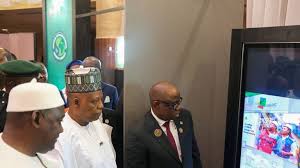




The Federal Government of Nigeria has reaffirmed its commitment to reform the country’s port operations, with a bold aim to reduce the average cargo clearance time to under seven days by the end of 2026 and to elevate Nigerian ports into the top three most efficient trade gateways across Africa.
During the second meeting of the Ports and Customs Efficiency Committee held at the Presidential Villa in Abuja, Vice-President Kashim Shettima emphasised the necessity of streamlining documentation and accelerating processing. He stated: “By the end of 2026, we aim to reduce average cargo clearance time in Nigeria to under seven days and to position our ports among the top three most efficient trade gateways on the continent.”
A key plank of this strategy is the planned rollout of the National Single Window (NSW) in the first quarter of 2026. According to the Vice-President: “The forthcoming implementation of the National Single Window will be a game changer—a single platform that harmonises documentation, minimises human contact, and brings full transparency to the cargo clearance process.”
In his remarks, Shettima pointed out that Nigeria’s current port performance remains far from its potential. At present, average cargo dwell time at Nigerian ports stands between 18 and 21 days, significantly higher than peer routes: five to seven days in Ghana and four days in Cotonou, Benin Republic. He further noted: “The cost of clearing goods in Nigeria is estimated to be 30 per cent higher than in many of our regional peers.”
Highlighting the scale of the challenge, the Vice-President described how Nigerian ports’ dwell times run 475 % above the global average benchmark. The inefficiencies aren’t just numbers; they translate into fewer investments, higher costs for consumers and weaker export competitiveness.
To tackle this head-on, Shettima directed major agencies, including the Nigerian Ports Authority (NPA), Nigeria Customs Service (NCS), National Agency for Food and Drug Administration and Control (NAFDAC), and the Standards Organisation of Nigeria (SON), to prepare a roadmap to strengthen Nigeria’s weights-and-measures framework, ensure accurate weighing and measuring of imports and exports, protect consumers, and enhance trade efficiency.
He also flagged the upcoming Executive Order on Joint Physical Inspection (awaiting presidential approval) as one of the boldest steps toward reversing existing inefficiencies. In his words, “It marks the dawn of a new era. An era where agencies work together, where systems speak a common language, and where traders and investors can depend on predictability, transparency, and speed.”
Speaking earlier, the Director-General of the Presidential Enabling Business Environment Council (PEBEC), Zahrah Audu, underscored the significant economic cost of port inefficiencies and urged stakeholders to align efforts to enhance the country’s ease-of-doing-business ranking. Likewise, NPA Managing Director, Abubakar Dantsoho, described the reforms, including technological adoption, infrastructure upgrades and human-capacity development, as critical for Nigeria’s competitiveness within Africa and beyond.
Former presidential candidate and ex-governor Peter Obi also weighed in, acknowledging the focus on the Lagos ports, but warning that too much concentration in one region creates congestion, high demurrage costs and environmental burdens. He stressed the need to diversify modernisation efforts across Nigeria’s maritime sector.
Economically, faster cargo clearance will lower logistics costs, boost export flows and attract foreign investment, thereby, potentially increasing Nigeria’s non-oil trade, reducing inflationary pressures from import delays and underpinning GDP growth. By cutting the expensive port bottleneck, this reform could significantly improve cost-competitiveness for Nigerian businesses and enhance the country’s global trade standing.