

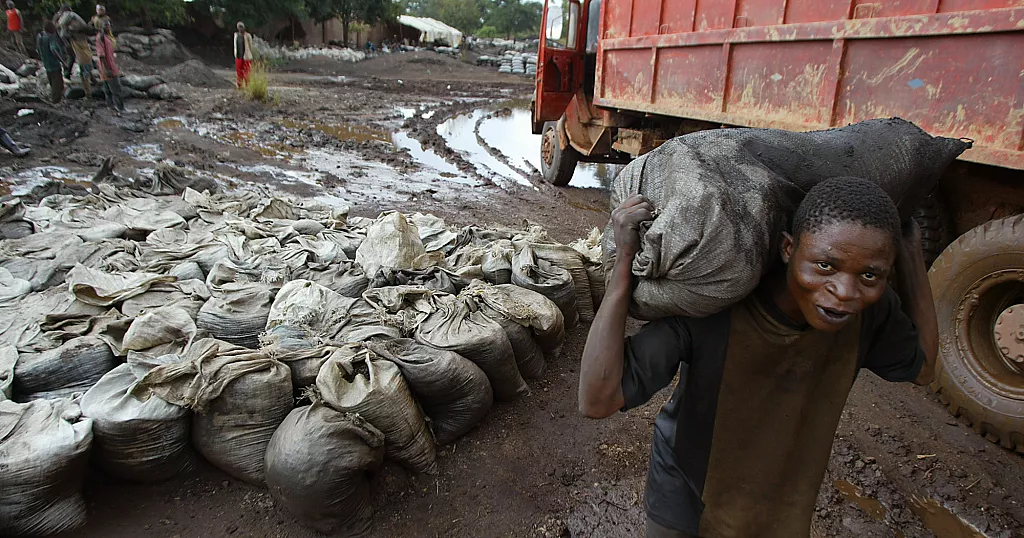
The Democratic Republic of Congo (DRC) will revoke cobalt export quotas from companies that fail to meet their production targets or breach tax, environmental, or compliance rules, according to a statement issued last Saturday by the country’s mining regulator. The new “use-it-or-lose-it” system, set to take effect on 16 October, marks a significant escalation in the DRC’s efforts to assert control over its cobalt sector, a cornerstone of the global electric vehicle (EV) and renewable energy supply chain.
The announcement from the Strategic Mineral Substances Market Regulation and Control Authority (ARECOMS) comes as cobalt exports resume under a newly regulated quota framework, following a months-long suspension aimed at curbing market oversupply and stabilising international prices. Congo, which produces more than 70 percent of the world’s cobalt, temporarily halted shipments earlier this year to reset market dynamics and tighten oversight of production volumes.
Under the new regime, companies that fail to export their allocated volumes, transfer quotas to third parties, or process unapproved artisanal cobalt risk losing their rights altogether. ARECOMS has also linked quota retention to compliance with traceability, environmental, and fiscal standards — a move analysts view as part of the government’s broader effort to align its mining governance with international environmental, social and governance (ESG) expectations.
Major Producers Dominate Allocations
According to the regulator’s directive, China’s CMOC Group, the world’s largest cobalt producer, received the largest export quota for the fourth quarter of 2025 at 6,500 tonnes, followed by Glencore with 3,925 tonnes. Together, they account for the majority of the country’s authorised exports for the period.
The remaining quotas have been distributed among a range of Congolese and joint-venture operators, including Gécamines, Entreprise Générale du Cobalt (EGC), Société du Terril de Lubumbashi (STL), Deziwa JV, Ruashi Mining, Chemaf, CDM (Huayou), and Musonoi JV. In total, twenty-one operators received allocations, with the top five controlling roughly 80 percent of total fourth-quarter exports.
The regulator also announced that from 1 January 2026, any unused monthly allocation would automatically be forfeited and redirected to a 9,600-tonne national strategic reserve managed by ARECOMS for “projects of national importance.” December 2025 allocations, meanwhile, will renew automatically for compliant operators next year.
Balancing Market Power and Sustainability
The DRC’s new approach underscores its growing determination to play a more active role in shaping global cobalt trade. For years, Congolese authorities have criticised foreign companies — particularly Chinese firms — for dominating extraction and export with limited local value addition. The new system, observers say, is designed not only to ensure compliance but also to strengthen state oversight, capture more fiscal revenue, and reduce speculative trading.
By conditioning quota renewals on environmental and tax performance, Kinshasa is also signalling a commitment to responsible mining practices. “This is part of a wider attempt to clean up the cobalt sector and demonstrate that Congo can be both a reliable and ethical supplier,” said a senior industry analyst at the African Mining Forum.
However, some companies have privately raised concerns that the system could create bureaucratic delays and supply chain uncertainty, particularly if quota enforcement becomes politicised or inconsistent. The DRC has previously struggled with regulatory transparency, and critics fear that sudden quota revocations could disrupt exports and exacerbate global price volatility.
Global Supply Chain Implications
The stakes are high. Cobalt is a critical component in lithium-ion batteries used in electric vehicles, smartphones, and renewable energy storage systems. Any disruption in Congolese supply could ripple through the global green technology industry, potentially increasing costs and slowing EV production.
The “use-it-or-lose-it” clause is seen by analysts as the DRC’s most assertive step yet to leverage its dominance in the market. It also reflects a growing pattern among resource-rich African nations — from Namibia to Zimbabwe — seeking to extract greater value and control from the export of strategic minerals central to the global energy transition.
China, which refines about 70 percent of the world’s cobalt, is likely to watch the development closely. CMOC and other Chinese operators have invested billions in Congolese mines, often through partnerships with state-owned Gécamines. Meanwhile, Western governments and automakers have been working to diversify supply chains amid increasing geopolitical competition over access to critical minerals.
ESG and Local Development
Congo’s new policy also comes amid growing international pressure to address ESG issues in the cobalt industry, including environmental degradation, poor labour conditions, and the exploitation of artisanal miners. ARECOMS’ traceability and environmental compliance requirements could help address these concerns — if properly enforced.
Entreprise Générale du Cobalt (EGC), a state-backed entity established to formalise artisanal cobalt mining, remains one of the few exceptions allowed to process third-party cobalt under the new rules. The government hopes this will help integrate artisanal miners into the formal economy while ensuring higher safety and environmental standards.
Still, implementation will be key. “Without transparent oversight and consistent enforcement, there’s a risk this system becomes another tool for rent-seeking rather than reform,” said a governance expert at the Natural Resource Governance Institute.
The Road Ahead
With the DRC positioning itself as a gatekeeper of one of the world’s most essential energy transition minerals, the impact of its new quota system will be closely monitored by investors, manufacturers, and policymakers alike. If successful, it could become a model for resource governance across Africa’s mineral-rich economies. But if poorly managed, it risks creating fresh uncertainty in an already volatile market — and testing the delicate balance between national sovereignty, global supply stability, and sustainable development.


