


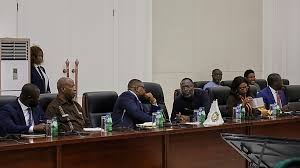

West African leaders have rejected a transition programme announced by Guinea-Bissau’s military rulers and demanded a swift return to constitutional order, warning that targeted sanctions could be imposed on individuals obstructing the process.
The Economic Community of West African States decided on Sunday at its annual summit in Abuja, Nigeria, following the overthrow of President Umaro Sissoco Embalo late last month. Army officers calling themselves the Military High Command seized power on 26 November and installed Major-General Horta Inta-a as interim president the following day, suspending constitutional governance in the small coastal state.
In a communiqué issued after the summit, ECOWAS said it did not recognise the transition roadmap announced by the junta and insisted on an inclusive and short transition leading to the restoration of civilian rule. The bloc also called for the immediate release of all political detainees and the protection of fundamental rights and freedoms.
The coup in Guinea-Bissau is the ninth military takeover in West and Central Africa in the past five years, adding to growing regional and international concern over democratic backsliding. Since 2020, a wave of coups has swept across Mali, Guinea, Burkina Faso, Niger, Gabon and Chad, straining ECOWAS’s credibility and capacity to enforce its norms against unconstitutional changes of government.
ECOWAS Commission President Omar Touray reiterated the bloc’s hardline stance, saying it maintains “zero tolerance for unconstitutional change of government”. He warned that ECOWAS was prepared to impose targeted sanctions, including travel bans and asset freezes, against those undermining efforts to restore constitutional order in Guinea-Bissau.
“Unconstitutional seizures of power threaten not only national stability but also regional peace and security,” Touray said, adding that ECOWAS would continue to engage with all stakeholders to ensure a rapid and peaceful resolution of the crisis.
The regional bloc said that presidential and legislative elections held in Guinea-Bissau on 23 November were judged to be free and transparent by ECOWAS observers, the African Union and other international partners. It said the military takeover came despite the credibility of the electoral process and therefore lacked any legal or democratic justification.
Guinea-Bissau has a long history of political instability and military interference in politics, with multiple coups and attempted coups since independence in 1974. While President Embalo himself survived an attempted coup in February 2022, ECOWAS said this did not legitimise the armed forces’ decision to remove him following elections that were widely endorsed by observers.
As part of its response, ECOWAS mandated a high-level delegation to travel to Bissau to engage directly with the military leadership, political actors and civil society. The mission is expected to press for the reinstatement of constitutional authorities and agree on a clear and credible timetable for elections, should a transition prove unavoidable.
The crisis also carries economic and security implications for Guinea-Bissau, one of West Africa’s poorest countries. Political instability risks disrupting donor support, foreign investment and budget financing at a time when the government relies heavily on external assistance. Any sanctions imposed by ECOWAS could further strain public finances and exacerbate hardship for a population already facing high poverty and limited access to basic services.
Regionally, ECOWAS leaders expressed concern that continued tolerance of coups could embolden military factions elsewhere and weaken collective security arrangements. The bloc has struggled to reverse recent takeovers, with prolonged transitions in Mali, Burkina Faso and Niger highlighting the limits of diplomatic pressure and sanctions.
Despite these challenges, ECOWAS said it remained committed to dialogue but stressed that engagement would not come at the expense of its core principles. “The restoration of constitutional order in Guinea-Bissau is non-negotiable,” the bloc said, signalling that the junta faces growing isolation unless it complies with regional demands.
For now, attention will focus on the outcome of ECOWAS’s planned mission to Bissau and whether the military authorities show willingness to compromise. The response of Guinea-Bissau’s armed forces is likely to test not only the bloc’s resolve, but also its broader strategy for confronting the wave of military rule reshaping the political landscape of West Africa.


