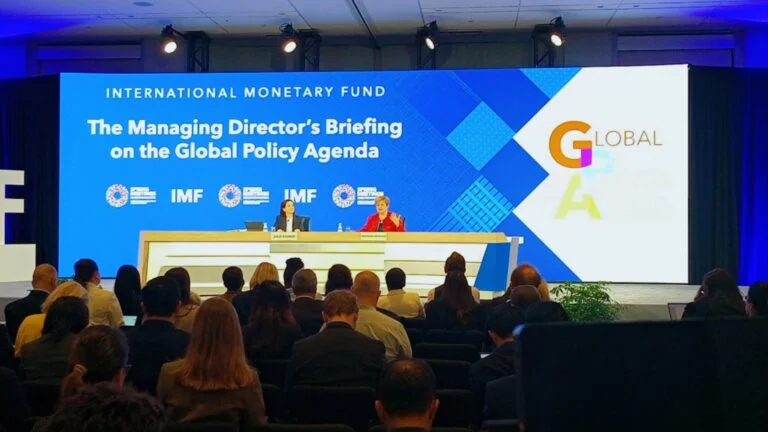

Growing conflict in the Middle East is causing widespread concern across the world, as global leaders hope the current ceasefire will last and eventually lead to long term peace for affected countries and economies.
The Managing Director of the International Monetary Fund, Kristalina Georgieva, shared this during a briefing on global economic policies held in Washington on Wednesday.
Georgieva explained that the ongoing crisis is severely damaging infrastructure in affected areas, while also disrupting supply chains and slowing down global economic growth. According to recent projections, global growth is expected to drop from 3.4 per cent last year to 3.1 per cent in 2026.
She warned that if the conflict continues and oil prices remain high, the situation could worsen significantly. This, she noted, may push the global economy toward a deeper slowdown, forcing governments around the world to make tough economic decisions.
She added that in a worst case scenario, global growth could fall further to about two per cent. Such a decline would impact all countries, as rising energy costs spread across markets and weaken economic stability globally.
Georgieva also pointed out that the effects of the crisis are not evenly distributed. She explained that energy importing countries, as well as low income and fragile economies, are likely to suffer the most due to limited financial capacity and weaker policy options.
She advised governments to focus on maintaining economic and financial stability in the short term. At the same time, she stressed the importance of carefully planned support measures for households and businesses affected by external shocks, in order to avoid creating additional economic problems.
Georgieva further encouraged central banks to adopt a cautious “wait and see approach” where conditions allow. However, she noted that some countries may still need to tighten their policies earlier depending on their economic situation.
She also raised concerns about rising global public debt, stating that it is expected to exceed 100 per cent of global GDP by 2029. This, she said, reflects the cumulative impact of repeated global crises and highlights the urgent need for balanced policies that can protect vulnerable populations.
According to her, the IMF remains ready to assist its member countries during this period of uncertainty. She revealed that financing needs could range between 20 billion dollars and 50 billion dollars through existing programmes and new support arrangements.
Georgieva concluded by saying that the IMF is working closely with global partners and improving its policy tools. These efforts are aimed at helping countries manage uncertainty, carry out necessary reforms, rebuild financial strength and better prepare for future economic shocks.