Nigeria’s financial system is entering a tighter phase as the Central Bank of Nigeria intensifies efforts to pull excess cash out of the economy. In a renewed push to curb inflation and stabilise financial markets, the apex bank has stepped up liquidity management operations, pushing the country’s money supply to its lowest level in four months.
Recent data from the central bank show that broad money supply, also known as M3, declined by 0.84 percent month on month to N123.36 trillion in January 2026, down from N124.41 trillion recorded in December 2025. The figure represents the weakest level since September 2025 and reflects the impact of aggressive liquidity tightening at the start of the year.
Money supply refers to the total amount of cash, deposits and other liquid financial assets circulating within an economy. Central banks regulate this measure to influence inflation, credit conditions and overall macroeconomic stability. When liquidity is tightened, borrowing becomes more expensive and spending across the economy tends to slow.
The latest contraction in Nigeria’s money supply reflects a deliberate effort by the central bank to withdraw excess funds from the banking system. Financial market data indicate that the apex bank mopped up about N13.41 trillion from the system in January alone. This is significantly higher than the N2.77 trillion absorbed during the same period a year earlier, signalling a stronger round of monetary tightening.
The liquidity drain forms part of a broader strategy to curb persistent inflationary pressure. Excess liquidity often fuels inflation by increasing purchasing power without a corresponding rise in the supply of goods and services. Nigeria has struggled with sustained inflation over the past two years, prompting monetary authorities to adopt stricter policy measures.
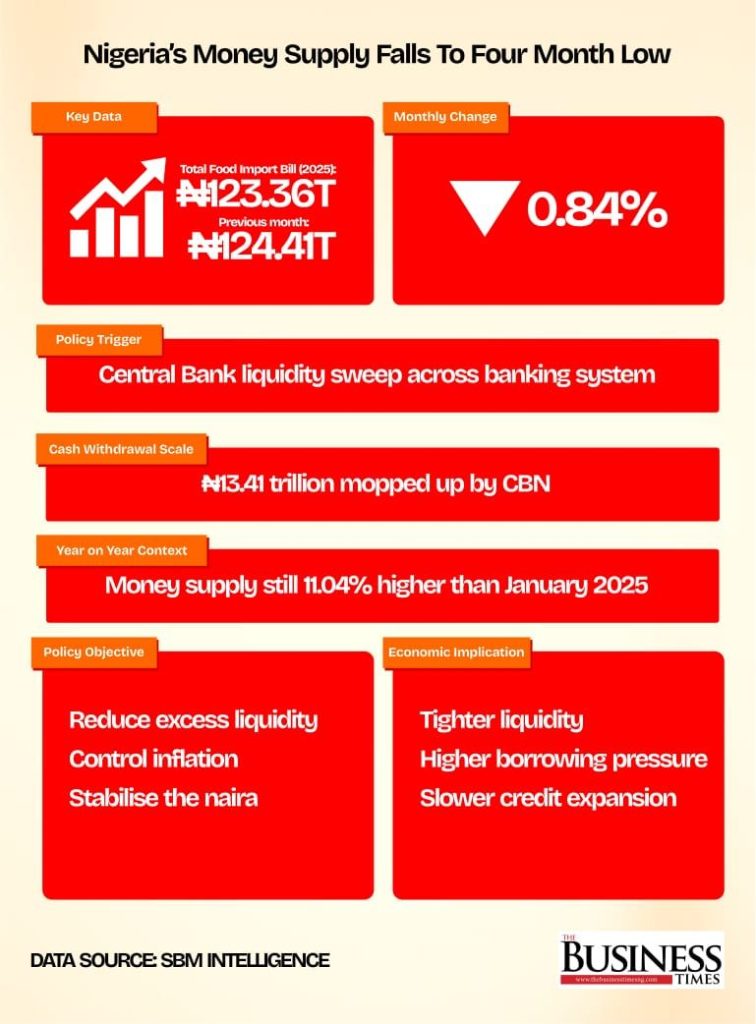
Despite the monthly decline, the broader trend still shows growth in the overall money stock. On a year on year basis, money supply rose by 11.04 percent from N111.10 trillion recorded in January 2025. This suggests that although liquidity growth is slowing, the amount of money circulating in the economy remains high.
Economists say tightening liquidity may help moderate inflation, but its impact could be limited if structural challenges remain unresolved. According to economist Ifunanya Uwanna, reducing the volume of money in circulation should theoretically slow price increases because fewer funds are chasing the same quantity of goods.
However, she noted that Nigeria’s inflation problem goes beyond monetary factors. Rising food prices, high transport costs, exchange rate pressure and insecurity in farming areas continue to drive inflation. “If tomatoes cannot reach the market, tightening liquidity will not suddenly make them cheaper,” she said, stressing that supply side challenges must also be addressed.
Tighter liquidity conditions are also expected to influence the lending behaviour of banks. When funding becomes scarce and borrowing costs rise, financial institutions often become more cautious about extending credit to businesses and households.
Uwanna explained that banks may increasingly prefer safer assets such as government securities instead of lending aggressively to the private sector. As a result, credit expansion could slow, particularly for small businesses that already struggle with high lending rates.
Banker Kemi Adeyemi shares a similar view. She explained that liquidity tightening forces banks to reassess risk and prioritise safer investments. According to her, lending will continue, but banks will become more selective about the borrowers they support.
She added that more funds are likely to move into treasury bills and other government instruments because they offer stable returns with lower risk. This shift could reduce the amount of credit available to businesses seeking funds for expansion.
The tightening cycle also raises concerns about the economy’s growth prospects. Monetary tightening typically slows economic activity because businesses rely on credit to expand operations. When borrowing becomes expensive, companies often delay investment decisions.
Uwanna believes economic growth can still occur, especially if productivity improves in sectors such as agriculture, manufacturing and services. However, she warned that prolonged liquidity tightening could slow overall economic momentum and produce uneven growth across industries.
Adeyemi also noted that growth may continue but at a weaker pace if restrictive monetary conditions persist. Many businesses tend to scale back expansion plans when financing becomes costly, reducing the pace of private sector investment.
Another objective of the liquidity tightening strategy is to stabilise the naira and reduce speculative demand for foreign exchange. When naira liquidity is abundant, individuals and businesses can easily move funds into the foreign exchange market to hedge against currency risks.
By restricting the availability of naira, the central bank aims to reduce pressure on the foreign exchange market. However, analysts caution that exchange rate stability depends largely on foreign currency inflows rather than liquidity conditions alone.
Adeyemi explained that stronger export earnings, improved oil revenue and increased foreign investment are essential for long term currency stability. Without these inflows, tightening money supply alone may not fully stabilise the naira.
Both analysts emphasise that monetary policy alone cannot solve Nigeria’s structural inflation challenges. While the central bank can manage liquidity and influence demand, broader economic reforms are needed to address supply constraints.
Such reforms include improvements in infrastructure, agricultural productivity, transport systems and security in farming communities. Without these changes, inflationary pressure could remain persistent despite tighter monetary conditions.
Prolonged liquidity tightening may also affect investment and job creation. Businesses could postpone expansion plans if financing remains expensive and difficult to obtain. Startups and small businesses are particularly vulnerable because they depend heavily on bank credit.
Over time, reduced lending activity could slow private sector growth and limit the pace of job creation across the economy. This highlights the delicate balance policymakers must maintain between controlling inflation and sustaining economic expansion.
For now, the decline in money supply underscores the central bank’s determination to restore monetary discipline and stabilise the broader economy.